
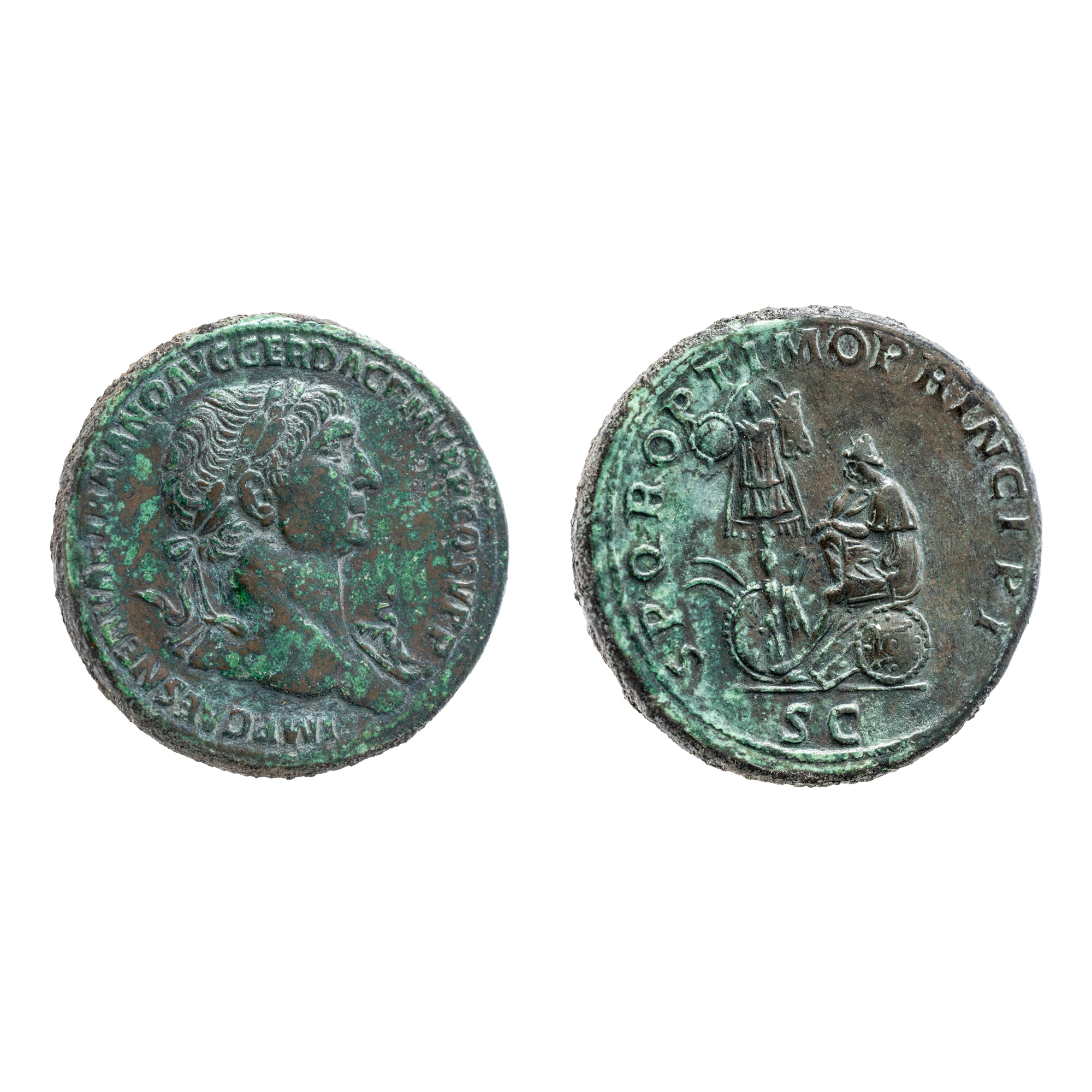
14C. Sestertius Coin, Trajan, Captured Dacian and Weapons Trophy type, circa 109 AD, exceptional piece
The photos of the lot are informative and indicative, and cannot provide a highly detailed view of the object from all angles. We recommend a careful physical inspection of the lot before bidding.

14C. Sestertius Coin, Trajan, Captured Dacian and Weapons Trophy type, circa 109 AD, exceptional piece


Starting price:
EUR 350
Sold
EUR 450

bronze, d=28 mm

PROVENANCE

The coin was purchased from an auction house in Osnabrück, Germany. The owner has all the acquisition documents, and copies of these, with personal data and prices erased, will be made available to the buyer.

Obverse: Bust of Emperor Trajan, laureate, to the right; Legend: IMP CAES NERVAE TRAIANO AVG GER DAC P M TR P P COS V P P. Reverse: Dacia seated to the left, on a shield, in front of it, a trophy; Legend: SPQR OPTIMO PRINCIPI. Minting area: Roman Empire, predominantly Rome. Circulation area: Roman Empire, from Spain to India and from Germany to Egypt. Possible discovery location: Western Europe, Central and Eastern Europe, Western Asia, North Africa. State of preservation: very good, with special patina. The Roman Imperial monetary system was created by Augustus. He restored the purity of the denarius, expanded the production of aureus, created new bronze denominations, reorganized the mints and expanded the use of Roman coinage and recognition systems. Shortly after 23 BC, Augustus instituted in Rome the new system of bronze denominations. Two alloys were used: sestertius = 25g, dupondius = 12.5g - orichalcum (20-25% Zn) and as = 11g, quadrans = 3g - copper. These four denominations were intended to facilitate small transactions. The iconography of the bronze coins reflects a Republican manner. The sestertii and dupondii have on their obverse an oak leaf wreath etc., and on the reverse the SC sign ("by the decision of the Senate") in a laurel wreath. The as also shows SC on the reverse. When the imperial iconography began to dominate, after 8-12 AD, the name and representation of the emperor under whom the coin was minted became defining. The presented sestertius is a relatively late one, from the period of Emperor Trajan. Like the other coins minted by Trajan for propaganda purposes, the bronze sestertius depicting on its reverse a personification of Dacia, seated on a shield, in front of a Roman trophy, plays a similar role in the emperor's campaign to praise the glory of the Roman Empire. At the end of Trajan's reign, in 117, the Roman Empire reached a peak in terms of both area and population.

For clarifications regarding the bidding procedure, hammer price costs, guarantee, payment, and collection terms for the winning lot, we recommend carefully reading/re-reading the Bidding Regulations.

For additional information regarding the lot and the auction, please contact the Art Consultants Department.

SESSION
Tue, 24 June 2025 18:00

Similar lots

25 Lei Coin 1906, Gold

58C. 25 Lei Coin 1906, Gold

    Starting price: EUR 1.000
    Sold EUR 2.750