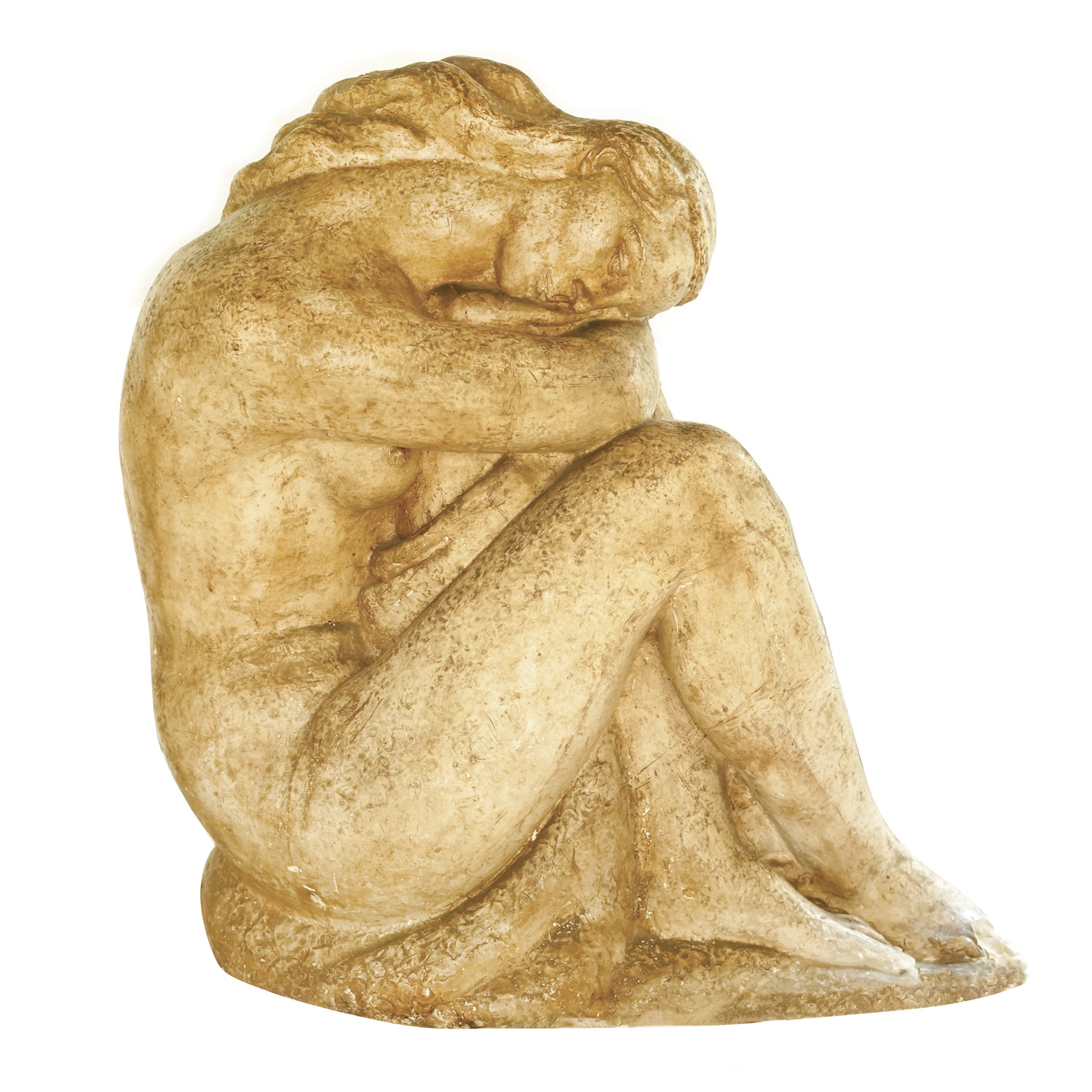
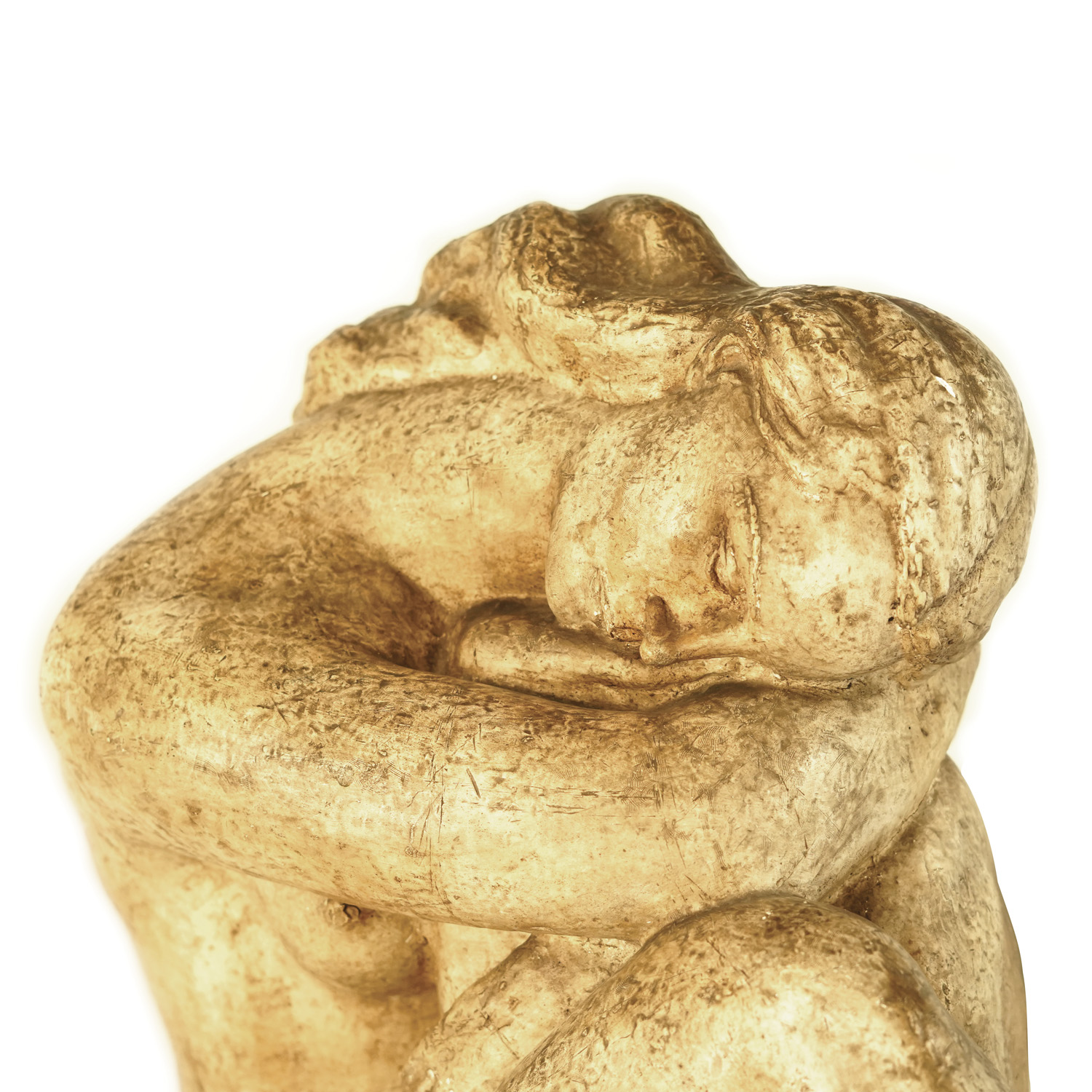
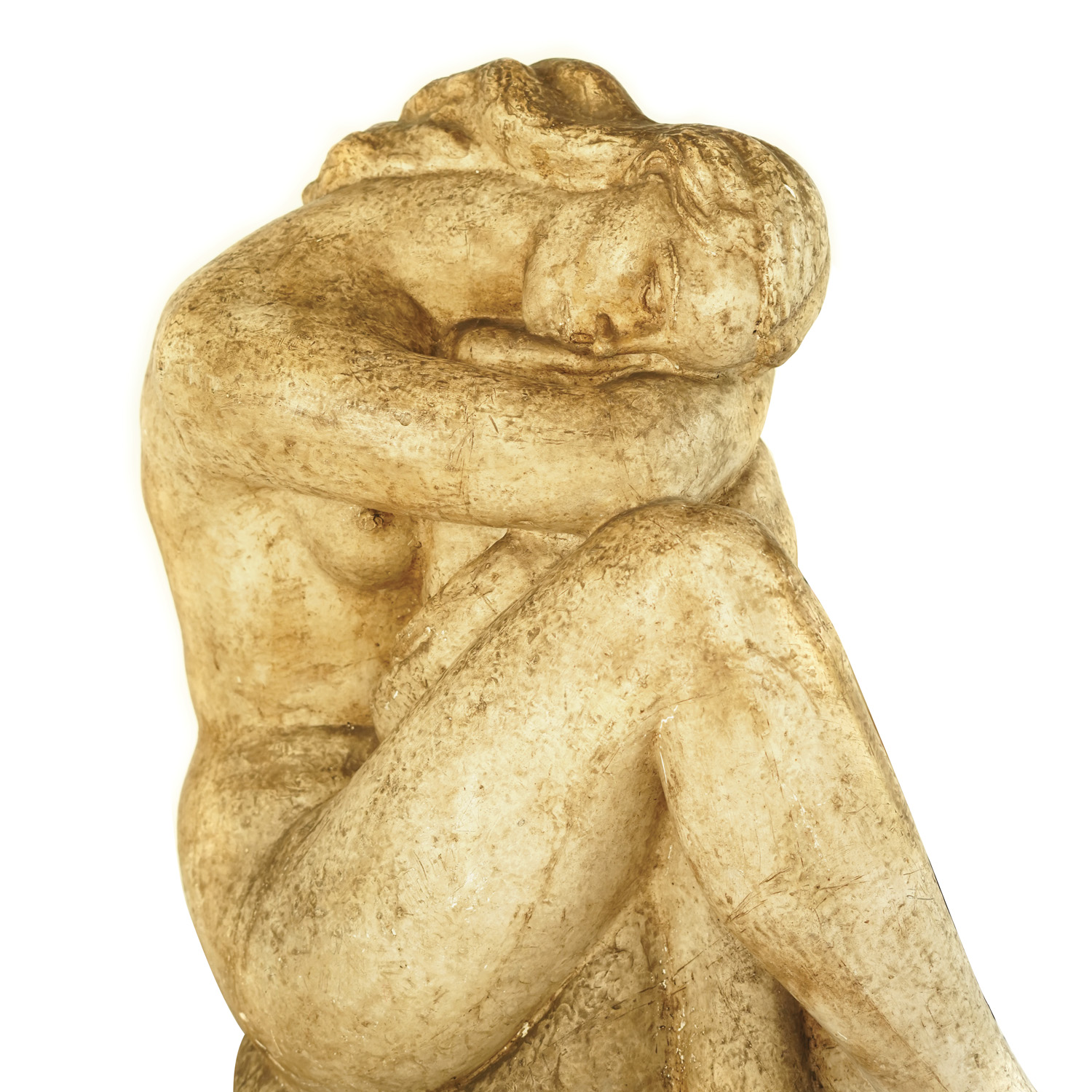
The photos of the lot are informative and indicative, and cannot provide a highly detailed view of the object from all angles. We recommend a careful physical inspection of the lot before bidding.
Rudolf Đurić, Artistic works of Mirogoj in the book “Mirogoj – cultural historical guide” (edited by Ivan Trčak), Christian Present and Rectorate of the Church of Christ the King, Zagreb, 1987., p. 84-85
Ariana Kralj & Vesna Mažuran Subotić & Lada Roje Depolo, Guide to the Glyptothek of the HAZU, Croatian Academy of Sciences and Arts, Zagreb, 2004., p. 40
Davorin Vujčić, Collection of the Antun Augustinčić Gallery / Fundus/, http://www.gaa.mhz.hr/fundus-s69
sadra, 87 x 86 x 46 cm
Research information
The version of the work is inventoried in the collection of the Glyptotheca under the number MZ-74.
PROVENANCE
The artwork was gifted to the family of the current owners in 1931; the artwork has been in the same collection for the past ninety-three years.
This work of the renowned Croatian sculptor of monumental monuments and public sculptures belongs to his lesser-known lyrical period, namely the period before the Second World War, during which he stood out as a sculptor of rare sensitivity and design strength, both in portraits of psychological and model excellence, and sensual and compact acts. The sculpture “Rest” was modeled and cast in plaster in early 1929, with the goal to exhibit it in November at the first exhibition of the art group of artists known as "Earth", of which he was a member. This is confirmed by the catalogue list of exhibits from the aforementioned exhibition held in the Ullrich Salon, where it states that Augustinčić then exhibited four sculptures, two of which were titled "On Break". One was cast in bronze and the other in plaster. It is likely that the damage to the thumb of the right leg of the curled woman occurred during the manipulation with her. The sculpture “Rest” was purchased in 1930 and taken over in an artisanal metal foundry in Harambašićeva street, where it was stored after the closing of the Earth group exhibition. The parents of the current owner received it as a wedding gift in 1931.
The Antun Augustinčić Gallery in Klanjec, the central museum institution for researching and collecting sculptor's works, keeps a number of such female acts and torsos dedicated to the beauty of the female body. Their creators are diverse from marble and bronze to plaster. Among them is the bronze casting of one of Augustinčić's versions of sculptures known as “Rest”. It was cast in 1930, carries the three-part title “Rest / Woman Sitting / Sorrow” and is significantly smaller in dimensions. It became part of the Augustičić collection in the gallery of Klanjec by purchasing from private owners and here's what the catalogue of the collection, its museum advisor Davorin Vujčić, says about it: “Curled up, naked female figure of long hair, her head resting on her left shoulder embodies a series of female figures of expressive lyricism with reminiscences of Art Deco stylization. Nostalgic associations, it served ideally as a tomb figure on the tomb of the Vajda family in Mirogoj in 1956. Another cast existed in family ownership in Dubrovnik, it was bought by Dr. Marko Polić, and the Gallery bought it from his daughter, Helly Polić from Zürich in 1998.” To Vujčić's record regarding the gallery sculpture “Rest” with additional titles “Sorrow” and “Woman Sitting” it should be added that the tomb figure on the Vajda family tomb was cast in bronze, 86 cm high, according to the molds that the sculptor saved in his studio, of course without damage to the thumb of the right leg, and that on that occasion and the Gliptotheca JAZU for its fund received the third plaster copy of this first-class Augustinčić's work. It is also worth mentioning that the Gliptoteka's specimen was temporarily relocated to Klanjec and exhibited at the exhibition "Antun Augustinčić - a selection of works from private and museum collections of Croatia" as "Female act". Antun Augustinčić studied sculpture at the Zagreb Academy of Fine Art and graduated in 1924 with Ivan Meštrović. After that, he went to Paris, where he honed his craft at the École des Arts Décoratifs and at the Académie des Beaux-Arts in the class of Jean-Antoine Injalbert for two years. Upon his return to Zagreb, he became involved in visual life, exhibited intensively and achieved significant success with his works. He was among the founders of the art group "Earth", and even briefly its vice president. His agreement with the members of the group - painters, sculptors, graphic designers, and architects - did not last and Augustinčić parted ways with the “earthlings” in 1933. Prone to a monumental treatment of volume and especially realism, he soon turned into a protagonist of public tasks. In his homeland and abroad, he had already gained a great reputation as a master of monuments, especially equestrian ones, before the war, and in the period after the Second World War, he gained the status of a “state sculptor”, performing numerous sculptural orders for the then establishment. He ran the master workshop for sculpture at the Zagreb Academy of Fine Art from 1949 to 1969.
The work needs conservation due to damage to the fingers on the right foot and one finger on the right hand.
For clarifications regarding the bidding procedure, hammer price costs, guarantee, payment, and collection terms for the winning lot, we recommend carefully reading/re-reading the Bidding Regulations.
For additional information regarding the lot and the auction, please contact the Art Consultants Department.
By choosing "Accept all cookies" you agree to the use of cookies to help us provide you with a better user experience and to analyse website usage. By clicking "Adjust your preferences" you can choose which cookies to allow. Only the essential cookies are necessary for the proper functioning of our website and cannot be refused
Cookie settings
Our website stores four types of cookies. At any time you can choose which cookies you accept and which you refuse. You can read more about what cookies are and what types of cookies we store in our Confidentiality Policy.
are necessary for technical reasons. Without them, this website may not function properly.
are necessary for specific functionality on the website. Without them, some features may be disabled.
allow us to analyse website use and to improve the visitor's experience.
allow us to personalise your experience and to send you relevant content and offers, on this website and other websites.