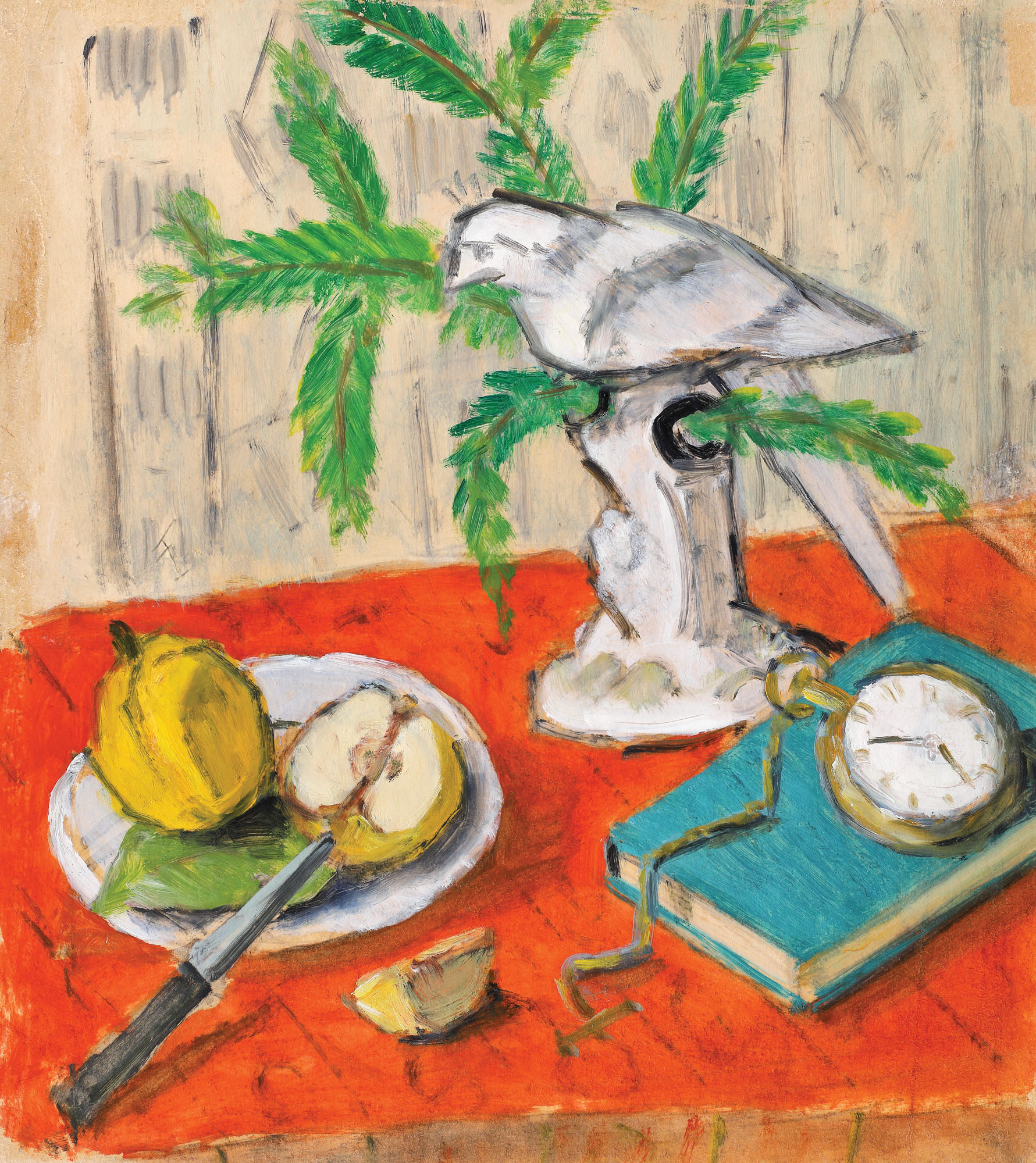
110. Still Life with Dove and Pocket Watch
Estimate
EUR 20.000 - 30.000
Sold
EUR 19.000
Session
Thu, 21 March 2024 19:00
References
"Drawings by Theodor Pallady from the Collection of the Museum of Crisana", in "Biharea", 1980, pp. 291-322. Florin Rogneanu, "Theodor Pallady and the Temptation of the Absolute", in "Oltenia. Studies and Communications", no. V-VI, 1986, pp. 205-209. SORBAN, Raoul, "Theodor Pallady", Ed. Meridiane, Bucharest, 1975. CEBUC, Alexandru, "Pallady", Ed. Official Monitor R. A., Bucharest, 2008.
Dimensions
width 41.5 cm, height 47 cm
Description
oil on paper glued to cardboard, signed on the left side, in pencil, "TP"
ADDITIONAL INFORMATION
For clarifications regarding the bidding procedure, hammer price costs, guarantee, payment, and collection terms for the winning lot, we recommend carefully reading/re-reading the Bidding Regulations.
For additional information regarding the lot and the auction, please contact the Art Consultants Department.
Detalii
ADDITIONAL INFORMATION
For clarifications regarding the bidding procedure, hammer price costs, guarantee, payment, and collection terms for the winning lot, we recommend carefully reading/re-reading the Bidding Regulations.
For additional information regarding the lot and the auction, please contact the Art Consultants Department.
References
"Drawings by Theodor Pallady from the Collection of the Museum of Crisana", in "Biharea", 1980, pp. 291-322. Florin Rogneanu, "Theodor Pallady and the Temptation of the Absolute", in "Oltenia. Studies and Communications", no. V-VI, 1986, pp. 205-209. SORBAN, Raoul, "Theodor Pallady", Ed. Meridiane, Bucharest, 1975. CEBUC, Alexandru, "Pallady", Ed. Official Monitor R. A., Bucharest, 2008.
Dimensions
width 41.5 cm, height 47 cm
Description
oil on paper glued to cardboard, signed on the left side, in pencil, "TP"
Similar lots