
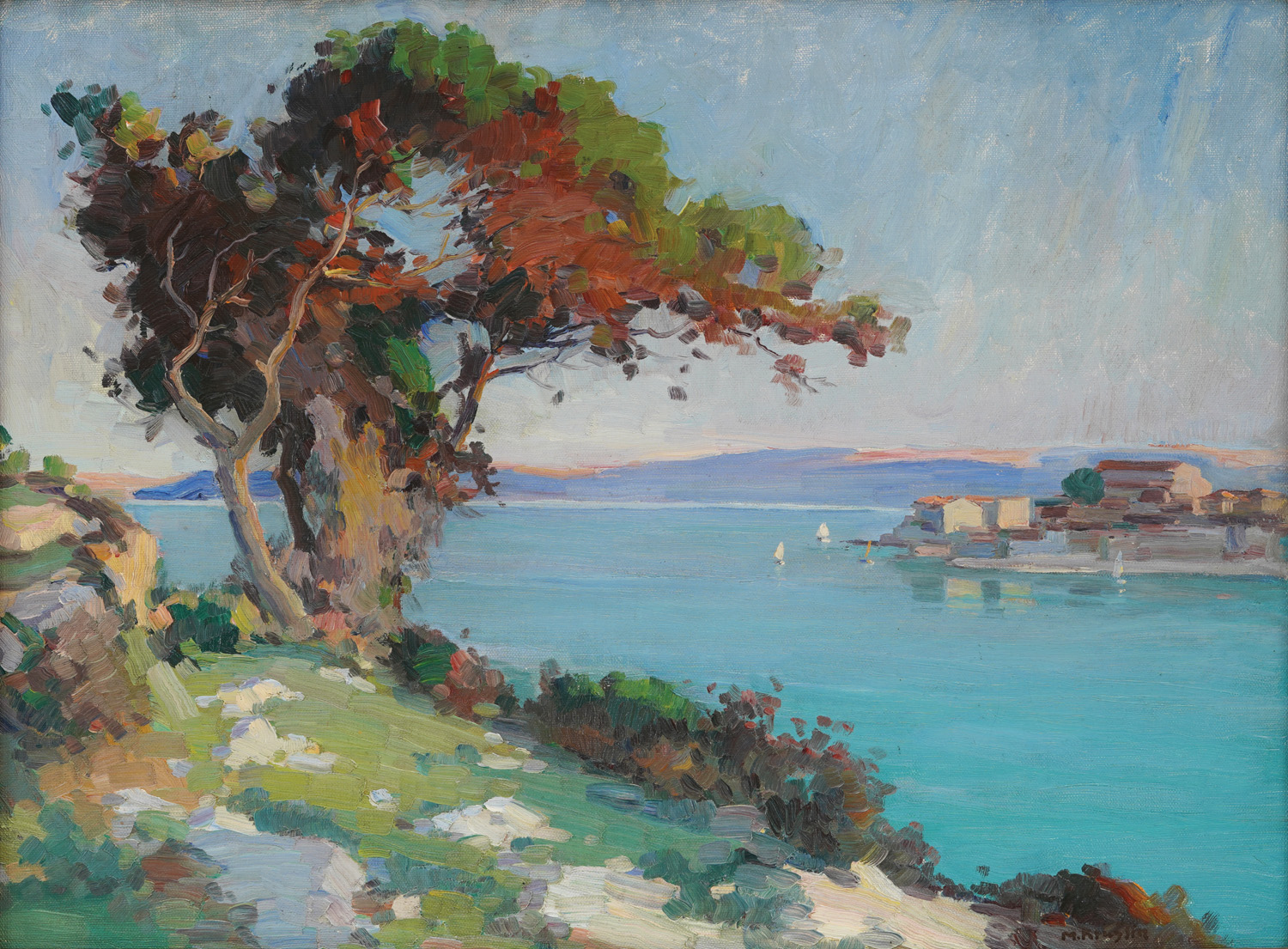
26. Trpanj Landscape [1938.]

1886, Slavonski Brod - 1954, Zagreb

Estimate

EUR 20.000 - 30.000

Sold

EUR 28.000

Session

Tue, 19 March 2024 20:00

Becić developed his inherent drawing talent after arriving in Zagreb (1904) by attending the private art school of Menci Cl. Crnčić and Bela Čikoš. A significant impetus to his painting ambitions was the simultaneous inclusion of his watercolor at the First Yugoslav Exhibition in Belgrade, where his work was among the works of Kovačević, Crnčić, Čikoš, Iveković, Meštrović and others. A year later, he broke through at the exhibition of the Croatian Society of Art in Zagreb and went on for further art education in Munich, where he first attended the private school of Heinrich Knirr, and then the Munich Academy. He studies in the class of Hugo von Habermann, and along with Račić, Herman, Kraljević and Nasta Rojc, he makes up the so-called "Croatian School", or the art group in Croatian art history known as "the Munich Ring." Soon, like Račić and Kraljević, Becić follows in their footsteps and goes to Paris where from 1909 he attended the Grande Chaumiére Academy. On his return, he stayed with his parents in Osijek, accepted portrait orders and painted landscapes of the Slavonian plain. In 1912, he accepted a job as a teacher at the Art School in Belgrade. After the Balkan War, he lived for some time in Bitola, and during the First World War he roamed the battlefield as a painter - a correspondent and lived in Rome and Paris for a short time. Upon returning to the country, Becić settled on his small estate in Blažuj near Sarajevo, where he gathered fellow painters (Vilko Šeferov and Karlo Mijić) and paved the way for his expressionist expression which would forever win the sympathy of the audience and criticism during the thirties. Without breaking off ties with Zagreb, Becić exhibited for the second time independently in the Ullrich Salon (1919), at the VII Spring Salon (1919/1920) and at the International Exhibition of Modern Art in Geneva, for which he was also one of the selectors. In 1923, Becić settled in Zagreb, became a teacher at the Art Academy, where he would train a number of generations of young painters over the next three decades. From then on, views of the Upper Town, the Zagreb Cathedral or the blooming orchards of Kraljevac and Šestina would alternate with landscapes of Blažuj and the seaside vistas of Dalmatia, where he was a regular guest during the free summer months until the end of his life. The exhibition "Four" (Babić, Becić, Miše, Vanka) in the Art Salon, actually in the apartment of the Osijek bookseller Radoslav Bačić, in 1928 marked a new period in Becić's work, and thus in Croatian painting. The four soon became the "Group of Three" (1929), which for several decades led and determined the direction of Croatian visual art. Becić participated in Zagreb in more than 15 large exhibitions, while simultaneously exhibiting abroad (Philadelphia, Boston) and other cities in the country. From 1934, he was a regular member of HAZU. (B.R.P.)

References

Zdenko Tonković, Vladimir Becić – retrospective (catalog), Art Pavilion, Zagreb, 1984. Zdenko Tonković, Vladimir Becić (monograph), Croatian Art Historians Society, Zagreb, 1988.

Dimensions

width 81.5 cm, height 60.5 cm

Description

oil on canvas, signed and dated lower right, in brown, "Vlad. Becić (1)938."

Research information

The thirties of the last century are marked in Becić's oeuvre by brilliant seaside landscapes from the south of Croatia, especially Orebić and the Trpanj area, where he regularly stayed during the free summer months and vehemently painted works that are among the top achievements of Croatian visual landscape art in the first half of the 20th century. Coloristic realism and tonally dimmed colors, surprisingly precise broad brush strokes with which he closes the frame of the picture - in factual and chromatic value - are characteristics of his painting that this picture vividly shows.

Dating

1938.

ADDITIONAL INFORMATION

For clarifications regarding the bidding procedure, hammer price costs, guarantee, payment, and collection terms for the winning lot, we recommend carefully reading/re-reading the Bidding Regulations.

For additional information regarding the lot and the auction, please contact the Art Consultants Department.

Similar lots
Long Live the King (study)

50. Long Live the King (study) [1911.]

Oton Iveković

    Estimate EUR 2.500 - 3.500
    Sold EUR 3.250
Autumn Field

75. Autumn Field

Nasta Rojc

    Estimate EUR 1.500 - 2.500
    Sold EUR 1.600
Chapter

71. Chapter [cca. 1940]

Ivan Meštrović

    Estimate EUR 15.000 - 25.000
    Sold EUR 32.000