
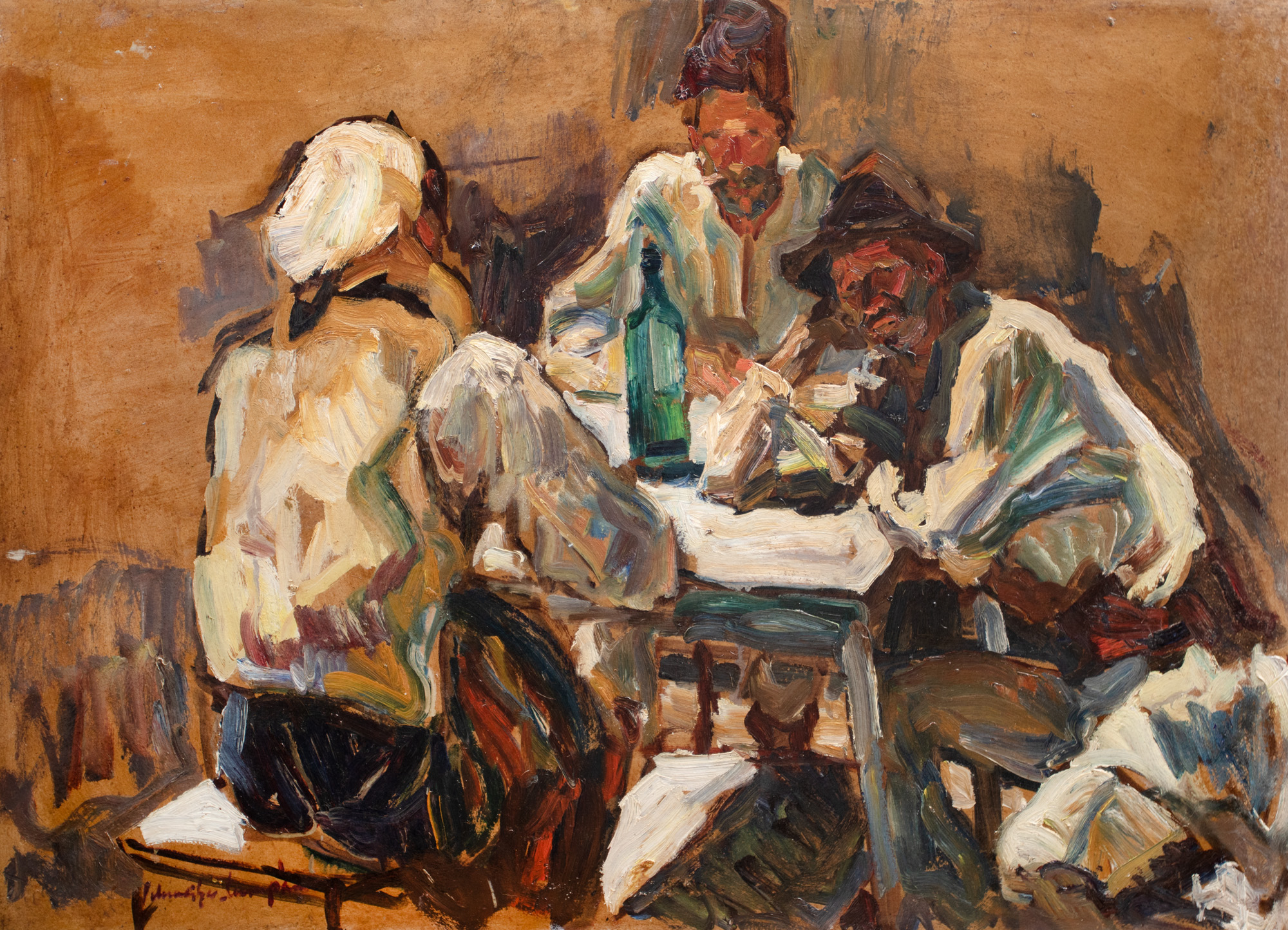
35. Peasants at the Inn [second half of the 20s]
1886, Piteşti - 1975, Bucureşti

Estimate

EUR 5.000 - 8.000

Sold

EUR 7.250

Session

Thu, 14 December 2023 19:00

Approaching themes and topics with a profound humanist nature, Rudolf Schweitzer-Cumpăna is inscribed in the history of Romanian visual arts as a true painter of the village and the local peasant. The childhood spent in the middle of nature, in the rustic atmosphere of Cumpăna, will transpose in an assiduous study of the life of the villagers of Argeș. The artist will transpose faces, ports, gestures and traditions in a series of frescoes dedicated to rural life. Among his main themes there are motherhood, work and care of the household or housework, transcribed in landscapes, portraits or genre scenes. The organic need to express in front of the easel will manifest almost incessantly - the artist works sometimes four to five works a day. The hustle and bustle and at the same time the quiet of rustic life is painted through his specific plastic language, by means of expression which undeniably enrich the artist's themes. Rudolf Schweitzer-Cumpăna uses powerful contrasts and relies on the incandescence of colour. He transposes his states of mind in intense light and shape games and reveals the revealing effect of colour laid directly on the canvas. He uses generous, rich paste, which he puts in harmonious touch-lines in fast, well-defined rhythms. He does not idolise the image of the peasant, but presents the simple, ordinary man, with his soul's anxieties and daily concerns. The drama of the artist's chromatic expressiveness is highlighted by his realistic vision. The solemnity of the gestures and the earthy nuances follow one another in works such as 'Peasants at the Table', 'Peasant Lunch' or even in the present work. The artist possesses a particular sensitivity and a remarkable power of understanding human psychology, so this time he gathers three characters around a table. We get a direct view of the faces of the two men, but we can only analyse the woman through the gestures of her back. The folk costumes, the handkerchief and hats; the worried faces and the desperate grimaces or the glass placed in the middle of the table reveal details of the personal universe of Schweitzer-Cumpăna's protagonists. The earthy tones used to create the background create a direct contrast with the bright white outfits of the characters. In keeping with the tradition of his favourite thematic cycle, the artist invites us, this time too, to delve into the mysteries of the village world.

References

BARBOSA, Octavian, 'Dicționarul Artiștilor Români Contemporani' ('Dictionary of Romanian Contemporary Artists'), Meridiane Publishing House, Bucharest, 1976. IONESCU, Radu, 'Rudolf Schweitzwer-Cumpăna', Fundația Rudolf Schweitzer-Cumpăna, Bucharest, 2003.

Dimensions

width 98 cm, height 71 cm

Description

oil on cardboard, signed bottom left, in brown, 'Schweitzer-Cumpăna'

Dating

second half of the 20s

ADDITIONAL INFORMATION

For clarifications regarding the bidding procedure, hammer price costs, guarantee, payment, and collection terms for the winning lot, we recommend carefully reading/re-reading the Bidding Regulations.

For additional information regarding the lot and the auction, please contact the Art Consultants Department.

Similar lots
The Blacksmith's Daughter

92. The Blacksmith's Daughter

Nicolae Vermont

    Estimate EUR 900 - 1.500
    Sold EUR 3.000
Vine Harvesting

114. Vine Harvesting

Samuel Mützner

    Estimate EUR 2.500 - 3.500
    Sold EUR 3.250
Horse Harness

3. Horse Harness [ca. 1880]

Nicolae Grigorescu

    Estimate EUR 800 - 1.200
    Sold EUR 2.000