
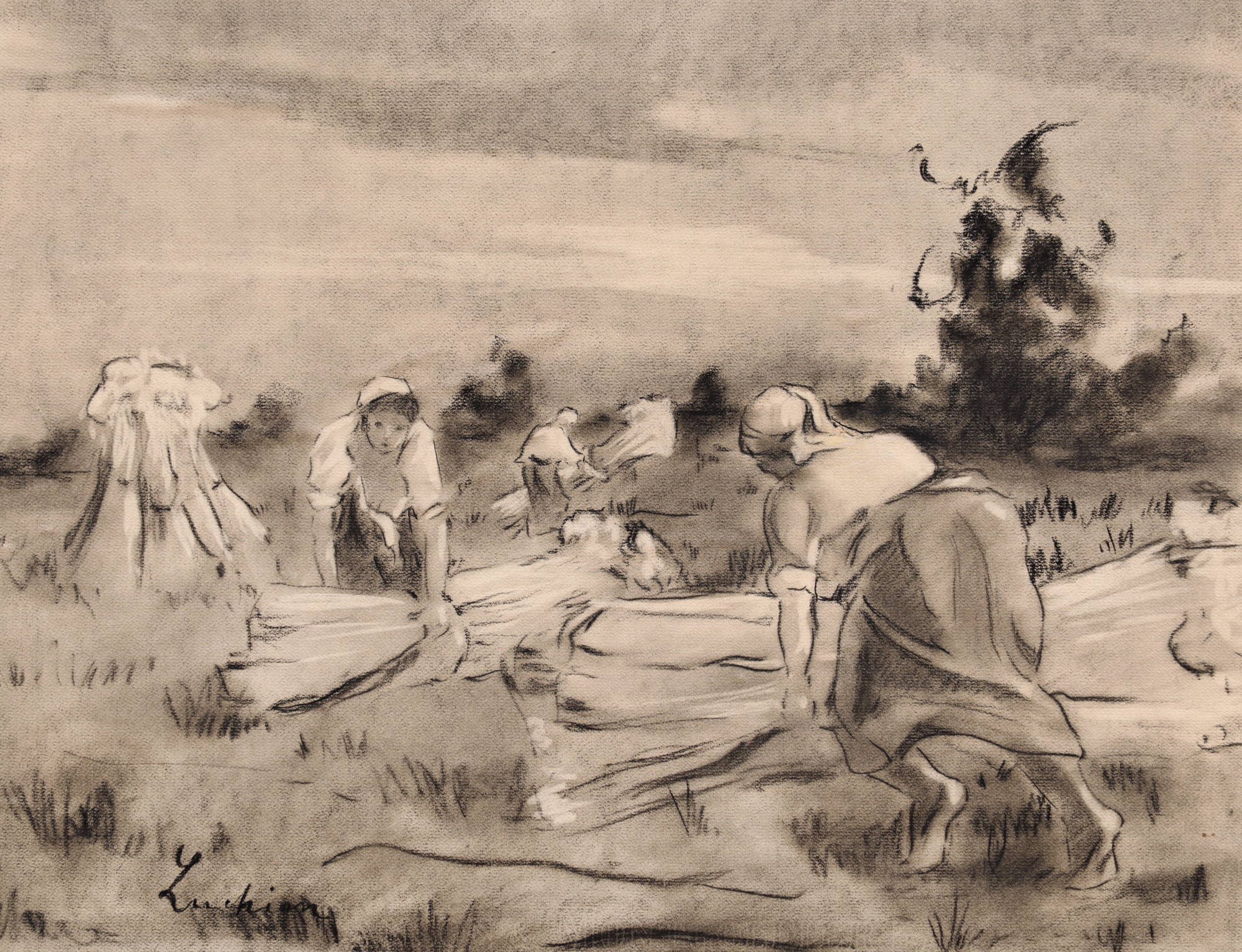
76. Harvesting [1907-1910]

1868, Ştefăneşti - 1916, Bucureşti

Selling price

EUR 16.281

Session

Thu, 14 December 2023 19:00

Along with his two younger brothers and the children from the neighbourhood, Ștefan Luchian often found himself playing in the streets neighbouring his house and often embarked on so-called expeditions to the Vergului Bridge, Obor or the merchants’ suburb. On Sunday, he went to church, where he was sometimes allowed to ring the great bell. Although he was the son of a former major-commander of the garrison in Ştefăneşti, Luchian did not attend the Infantry School, but he simultaneously studied Fine Arts and the Conservatory. The classes attended under the guidance of Theodor Aman or Gheorghe Tattarescu provided him with the necessary framework for acquiring prodigious knowledge in the art of drawing, which he would apply religiously in the features of his characters. He therefore studied the academic perspective of art, the same perspective he would encounter in his travels through the capital of Bavaria. In Munich, he makes copies after the great masters exhibited in the Old Pinakothek– we note here the transcript of Rembrandt’s work, 'The Holy Family', which represents a revealing episode in his trajectory. He then goes to Paris, where he discovers a new cultural horizon, much more suited to his temperament. With the skill of the self-taught, he delights in the study of great artists exhibited in museums and galleries. The year 1891, an important year in the economy of universal art, brought the Romanian artist face to face with the works of Seurat, Signac, Toulouse-Lautrec, Manet and Van Gogh. Back in the country, he turns his attention to the picturesque theme and exhibits works dedicated to the subject. In the history of Romanian art, Luchian remains known as a painter of flowers and a master of portraiture. A convinced humanist, he uses art to penetrate more easily into the psychology of his characters. However, the musicality of his visual work is especially translated into female faces and physiognomies. He often captures elegant, mysterious, graceful women who seem to 'pose' with the obvious influences of French Impressionism. But he sketches bodies of village women, captured while working in the fields. Luchian summarises his observations of nature in a graphic cycle that has at its centre the human figure and the natural setting in which people work. Sheep grazing, carts of oxen on country roads, female characters captured while gathering hay or mowing will be the themes of rural inspiration that will animate the artist's work once back in the country. This time, he adopts a more sober palette and relies on the pronounced play of light and shadow games. In the present work, the serious, hard tones are transformed into firm outlines of the landscape, the characters or the birds floating in the sky. Much darker and lacking the primordial vitality found in his oil paintings, the present work nevertheless becomes representative and goes beyond a simple plein-air transcription.

References

LASSAIGNE, Jacques, 'Ștefan Luchian', Meridiane Publishing House, Bucharest, 1972. CIUCĂ, Valentin, 'Pe urmele lui Ștefan Luchian' ('In the footsteps of Ștefan Luchian'), Pim Publishing House, Iași, 2016. MARINACHE, Oana, 'Casele familiei Luchian și arhitecții lor' ('Luchian family houses and their architects'), 2016.

Dimensions

width 61.5 cm, height 47.5 cm, custom 47,5 × 61,5 cm

Description

charcoal on paper, signed bottom left, in charcoal, 'Luchian'

Dating

1907-1910

ADDITIONAL INFORMATION

For clarifications regarding the bidding procedure, hammer price costs, guarantee, payment, and collection terms for the winning lot, we recommend carefully reading/re-reading the Bidding Regulations.

For additional information regarding the lot and the auction, please contact the Art Consultants Department.

Similar lots