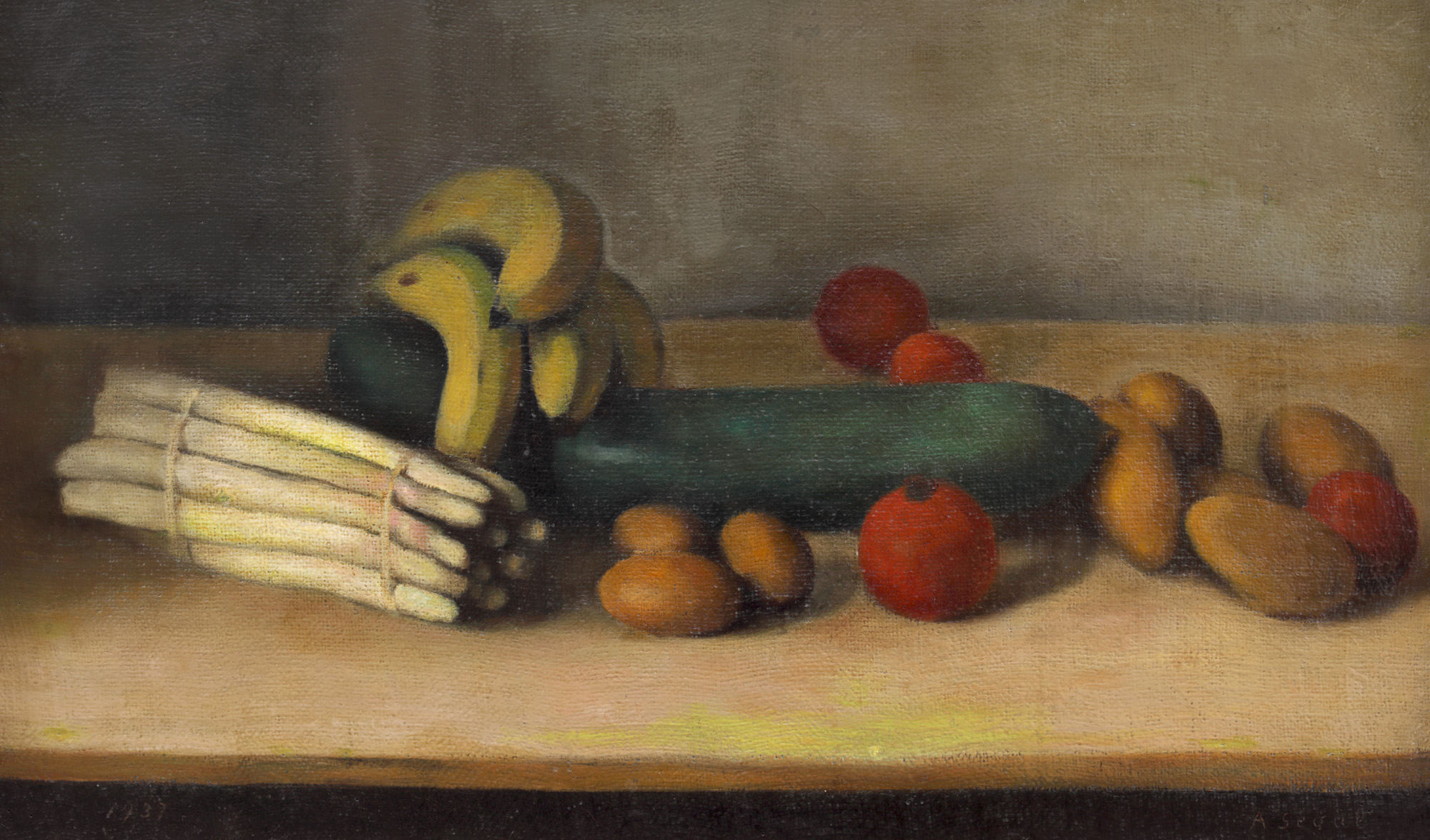

144. Fruits and V [1937]

1875, Iaşi - 1944, Londra

Estimate

EUR 6.000 - 9.000

Session

Thu, 14 December 2023 19:00

With a clear inclination towards the arts, Arthur Segal gives up the idea (instilled by his family) of a career in business and heads for Berlin to further his cultural studies. He will make contact with Impressionism and will travel through the important European artistic centres of the time (Berlin, Paris, Munich). His career will therefore be marked by a thirst for knowledge and will pass, without failure, through the attributes of Impressionism and Neo-Impressionism, of the avant-garde and especially of Dadaism, and then will converge towards his own style, touched by the influence of Expressionism. From the 1920s onwards, Segal showed a real interest in naturalism and objective principles in painting. In 1937, Arthur Segal founded the 'School of Painting for Professionals and Non-Professionals' in London, a school that focused on the use of painting as a form of psychotherapy. His institution enjoyed a unique niche: Influential psychologists and psychoanalysts began referring patients to Segal for treatment, and even insisted that they attend training courses to learn his therapeutic methods. Supported by personalities such as Sigmund Freud or Ernest Jones, Arthur Segal will succeed in settling in London for good, and at the same time, will continue to work in the United Kingdom. Building on the success of his school and its work in general, the artist begins to theorize his painting methods and art psychotherapy practices and lays them down in the form of a thesis - 'Principiile Obiective ale Picturii' (The Objective Principles of Painting) - which summarizes the system on which his work is based. The end of the 1920s marks his shift from avant-garde to naturalism. Static natures inspired by immediate reality are now increasingly appearing: fruit, vegetables, vases or flower pots. The painter finds inspiration in everything that surrounds him, so, in this work, we can distinguish the simplicity and the lack of overzealousness of the mature artist. The vivid colours exemplified in shades of yellow, red or green and the fine brushstrokes still reminiscent of the Impressionist period portray Arthur Segal at the end of an initiatory journey that proves to be revealing for the shaping of his own style. The background gradient and the suggestion of the table plane amplify the expressiveness of the whole composition. Bananas, tomatoes, potatoes or cucumbers go beyond their primary condition as food and take on a decorative-aesthetic role. This decorative valence will be the artist's main focus throughout a longer series of works that mark his stylistic transfer. With his move to London, Arthur Segal will focus less on his exhibition work in favour of psychology, psychoanalysis and pedagogy. Works such as this one recall artistic mastery and bring to the fore the cognitive capacities of the artist who demonstrates a clear passion for psychology.

References

PAVEL, Amelia, 'Pictori evrei din România' ('Jewish painters from Romania'), Hasefer Publishing House, Bucharest, 2003.

Dimensions

width 78 cm, height 47.5 cm, custom 47,5 × 78 cm

Description

oil on canvas, signed bottom right, in brown, 'A. Segal'; dated bottom left, '1937'

Dating

1937

ADDITIONAL INFORMATION

For clarifications regarding the bidding procedure, hammer price costs, guarantee, payment, and collection terms for the winning lot, we recommend carefully reading/re-reading the Bidding Regulations.

For additional information regarding the lot and the auction, please contact the Art Consultants Department.

Similar lots