The photos of the lot are informative and indicative, and cannot provide a highly detailed view of the object from all angles. We recommend a careful physical inspection of the lot before bidding.
BREZIANU, Barbu, "Nicolae Grigorescu", Ed. Meridiane, Bucureşti, 1987 ENACHE, Monica (şi alţii), "Grigorescu – pictor al naturii, (catalog)", MNAR, 2008 NICULESCU, Remus "Expoziţia Nicolae Grigorescu, catalog" de, Muzeul de artă al Republicii Populare Române, Bucureşti, 1957 OPRESCU, George, "Nicolae Grigorescu, maturitatea şi ultimii ani", Bucuresti, ed.Meridiane, 1970 VLAHUŢĂ, Alexandru," Pictorul Nicolae Grigorescu", Bucureşti, 1910
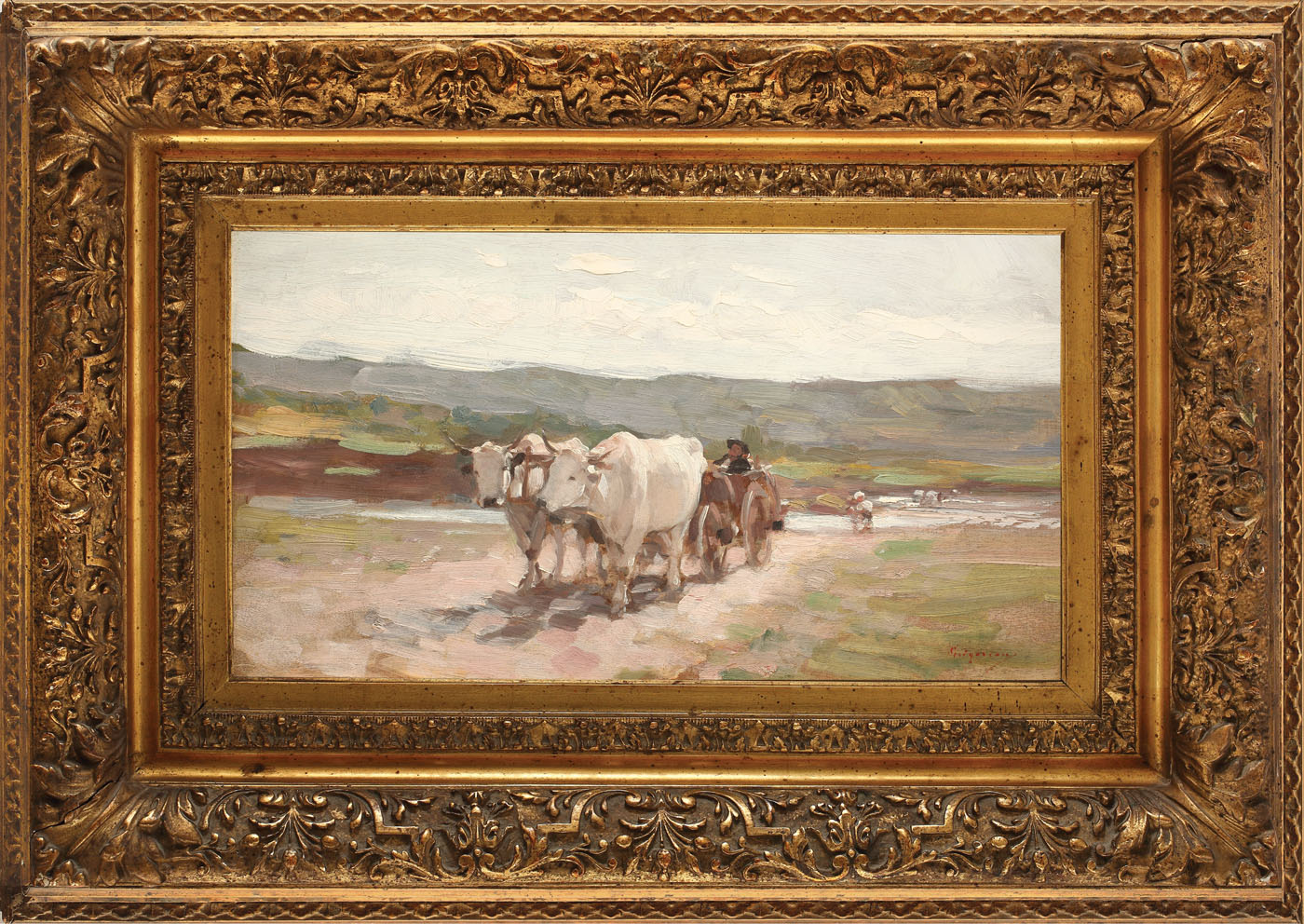
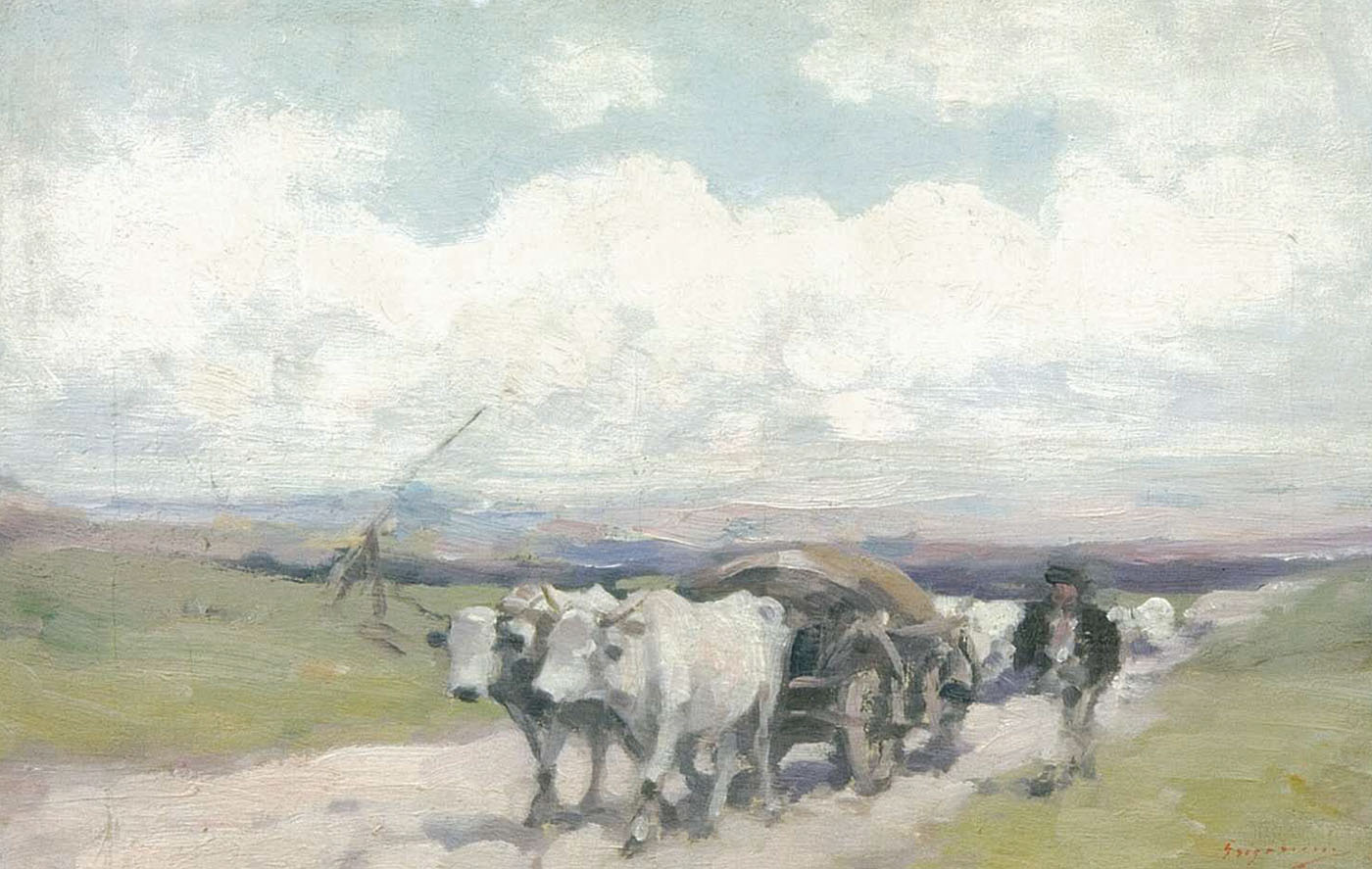
oil on wood, 24.5 x 45 cm, 45x24,5, signed lower right, in red, "Grigorescu"
Material / Carats
ulei pe lemn
The life of the Romanian peasant found its eulogy in Grigorescu's work, as in Millet's, where the French peasant became the pillar of an era. The Romanian version that Grigorescu managed to interpose to the subjects he took resulted in the designing of motifs dislodged from time and space, even if the characters could be reintroduced anytime, either in the primeval rural area or in the meadows and valleys of Muntenia. The main effect achieved by the painter was to avoid genre scenes in the landscape, a pictorial typology that we encounter in Aman's "landscapes". As far as this thematic cycle is concerned - the peasant's life, it becomes essential in the maturity phase, even progressing towards the "white" period. This essentialisation led to the remodelling of the peasant figure, which, transposed by emblematic but not individual silhouettes, led to the creation of the idyllic painting of village life. Thus we get the typical model of female beauty, represented by the faces of young, always cheerful peasant women, the model of the peasant or the shepherd, slender, playful, yet dignified, or the typology of labour, always presented in its marginal phases, departure or return from the fair or field. If we appeal to the entire imaginary of Grigorescu, we notice how labour disappears, but the human group is always present, either in ox carts or in actual caravans to or from the actual place of activity. It is precisely this extraction of actions from the pictorial discourse that characterises the cycle of ox carts, a motif charged with the lyricism typical of a state of temporal suspension. The motif of the road attracts Grigorescu especially as regards the initial specificity of the whole activity. Without abandoning his plein air desiderata, all visual sources are integrated into the landscape, or rather into nature, as the owner of the compositional frame. Thus, in the artist’s plastic development, colour and light remain primordial. Repeating the motif of the ox cart, or that of other dear subjects, has led to negative criticism, Grigorescu being considered a mannerist. But the pictorial act itself largely denies this more or less negative valence. "Repetition in art? - woe to the one who, looking at a beautiful thing, a living one, because all the beautiful things are alive, looking at it only once and only from a single point of view, thinks he has seen it enough". This is what Grigorescu stated when questioned in this regard. Besides, his entire maturity period was characterised by a painting ruled by feelings. Thus, emotion has taken refuge in brushstrokes, so prominent in his last years of creation. Especially after 1890, when Câmpina and its surroundings became the main source of visual inspiration, Grigorescu created that rustic imagination, and most landscapes, with or without human presence, are defined by the free, cheerful touch that does not betray at all the hand of someone who repeats himself unaesthetically. If we scrutinise the entire creation of Grigorescu, the one relevant to the period and the cycle in which “Ox Cart” belongs, we can easily observe the primacy of a certain way of painting. This typicality is immortalised in the myriad ox carts that seem to come, of course, from the point of view of Grigorescu the observer. Almost all scenes that depict and portray the life of the Romanian peasant are characterised and painted in a more than optimistic spirit. That idealisation materialised in the presentation, without flaw, of a carefree, lively life, even in a relaxed and cheerful spirit. The vicissitudes of life are excluded by Grigorescu, who always chooses generalised, true subjects, yet always filtered through his own aesthetic vision, which obviously does not tolerate the ugly and heavy parts of existence. Starting from here, we can extrapolate and conclude that the painting of the passing motif (exactly, but also figuratively) seems a little distinct. Grigorescu must have questioned the timelessness of the subject, which thus painted, fell prey to time - time ages, renders ugly and kills. But the small wooden panel (24.5 x 45 cm) is built by Grigorescu according to established painting precepts, the chromatic effects becoming the only ones prone to biased interpretations. The subject is not charged with transient sensations, but is found among works made for their purely pictorial effect. This personalised Impressionism of Grigorescu, a style appropriated precisely by the juxtaposing of national motifs to compositions, comes to complete the artist's vision of the work he sees, his sensations and feelings being limited to the directly sensorial, visual, perhaps even tactile level. The fluidity of the paste gives the impression of instantaneous, the instance being subjugated exclusively to colour and brushstrokes. The landscape is presented in a bright afternoon light, which is particularly revealed by the effective painting of the heavenly register (the white thickened with the palette knife). The freshness and vivacity of the composition are achieved by the valuable opposing of the sky, painted in the most diaphanous accords of white, with the terrestrial register, shaped in variations of penetrating intensities, typical of the surface (vegetal green, earthy ochre).
For clarifications regarding the bidding procedure, hammer price costs, guarantee, payment, and collection terms for the winning lot, we recommend carefully reading/re-reading the Bidding Regulations.
For additional information regarding the lot and the auction, please contact the Art Consultants Department.