The photos of the lot are informative and indicative, and cannot provide a highly detailed view of the object from all angles. We recommend a careful physical inspection of the lot before bidding.
COMARNESCU, Petru, „Luchian”, Ed. de Stat pentru Literatură şi Artă, Bucureşti, 1955
JIANU, Ionel, „Luchian”, Ed. Căminul Artei, Bucureşti, 1947
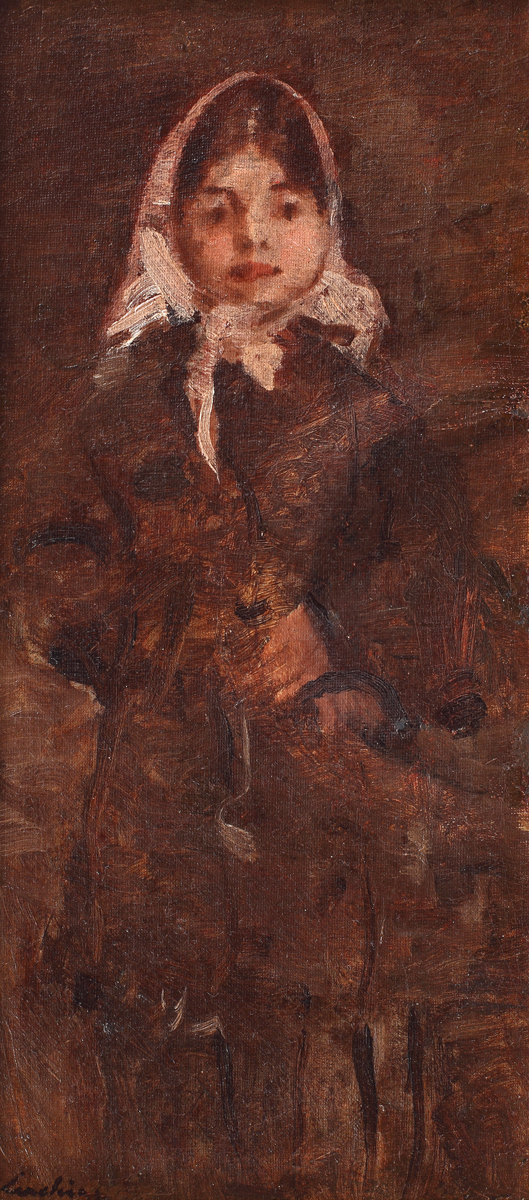
oil on canvas, 36 x 16.5 cm, 16,5x36, signed lower left, in brown, "Luchian"
Research information
Opera este însoțită de o declarație a ultimului membru al familiei Oteteleșanu ce a deținut opera, Șerban Tudor Oteteleșanu: “Aceasta operă există în familia mea din anii 1920-1923 .... Tabloul este cuprins în Declarația pentru patrimoniu înregistrată la nr 2229 din 3 Ianuarie 1975.”
PROVENANCE
1920-1980, historical collection of the Oteteleșanu family; post-1980, historical collection of Dr. Constantin Amza, founder of the gynaecology school of Medgidia.
Ștefan Luchian enrolled in 1883 at the School of Fine Arts in Bucharest, defying his family plans, who insisted he should have a military career and study at the Infantry School. Some of his professors at the School of Arts were Theodor Aman and Gheorghe Tattarescu, in drawing and painting, Dr. Polizu in Anatomy, and C. Stăncescu in Art History, as the atmosphere was ruled by a conformist Academicism. Luchian participated with great interest in his drawing and composition classes, attracting the professors’ appreciation, but he truly disliked theoretical lessons. In the doctrinal and conventional climate of the school, Grigorescu's example was used to designate amateurism, but for Luchian, who did not resonate with the principles advocated by his professors, Grigorescu was the true artist. From the lesson of master Grigorescu, whose style he copied for a few years at the beginning of his career, Luchian evolved to his own style during the 1890-1900 decade. After finishing his studies at the School of Fine Arts, he left for Munich in 1889, the first stop on the training itinerary followed by the artists of the time, then in the spring of 1891 he continued his journey to Paris. In Munich he visited the museums and the cafes where artists met, without taking any lessons with a master or studying in any workshop. Luchian understood that the academic environment in Munich could only provide him with technical directions and the same sterility of thought that he already knew from his own country, so he decided to go to Paris, where new horizons awaited. The Parisian period (1891-1893) completed Luchian's artistic education and his return to the country meant both the beginning of his integration into the artistic society and his moment of artistic maturity.
As early as the achievements from his first creation period in Romania, namely 1894-1896, Luchian proved he was a great portraitist, with "Safta the Florist", a painting from 1895, becoming one of his most famous portraits. Here, Luchian manages to give the character a disturbing power of expression, with her features, attitude, but above all her gaze, hinting at a whole universe of emotions. It was precisely the period when Luchian accepted Grigorescu’s lesson, when he even adopted some of his subjects (compositions with peasant girls) and the moment when his creation headed to the great works of his maturity. The man then entered the painter's view, his creation focusing on the appearance and representation of the individual until the end of his days.
Along with the faces of his daily life, Luchian also studied life in the village, and his creation includes important cycles dedicated to the simple man. From gardeners to gypsies and florists, Luchian excelled through brushstrokes and colour in portraying relevant pictorial instances. This work, painted at the turn of the 20th century, can be found in a wider series of faces that Luchian captured in various compositions. Together with "Peasant Woman with Pitcher", "Gypsy Woman among Marigolds", "Laundress", "Going Home after Work", "The Beggar" or "On the Porch", "Little Girl" manages to reproduce a deeply intimist universe that Luchian appropriates.
For clarifications regarding the bidding procedure, hammer price costs, guarantee, payment, and collection terms for the winning lot, we recommend carefully reading/re-reading the Bidding Regulations.
For additional information regarding the lot and the auction, please contact the Art Consultants Department.