The photos of the lot are informative and indicative, and cannot provide a highly detailed view of the object from all angles. We recommend a careful physical inspection of the lot before bidding.
DAVIDESCU, Cătălin, "Țuculescu", Scrisul Românesc Publishing House, Craiova, 1988.
Catalogue of the retrospective exhibition "Ion Țuculescu 1910-1962", National Art Museum of Romania, 1999.
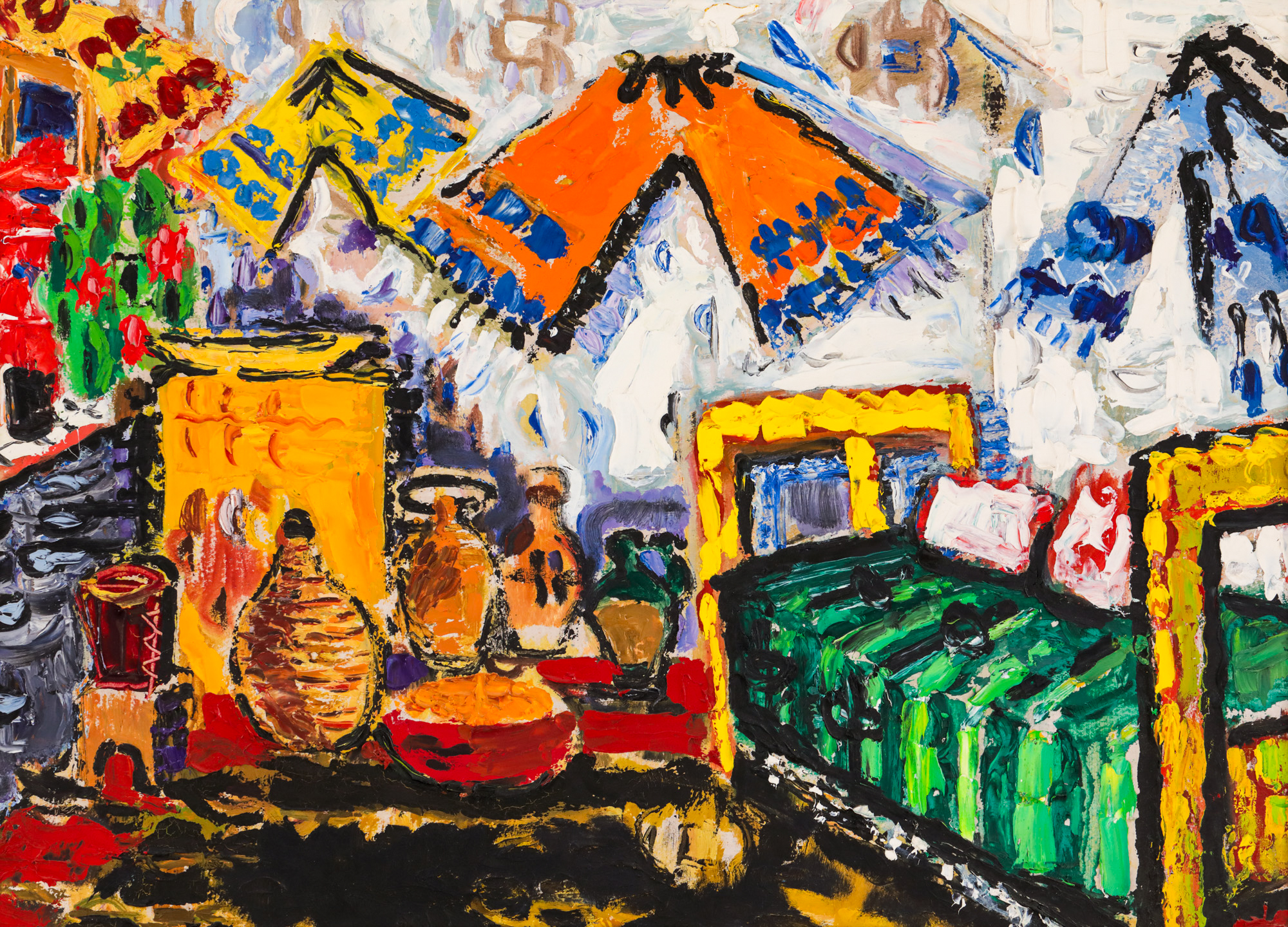
oil on cardboard, 48.5 x 67.5 cm
Research information
The work participated in the retrospective exhibition "Ion Țuculescu" at the National Museum of Art of Romania, February - May 1999, cat. 104.
PROVENANCE
Șerban Țuculescu collection.
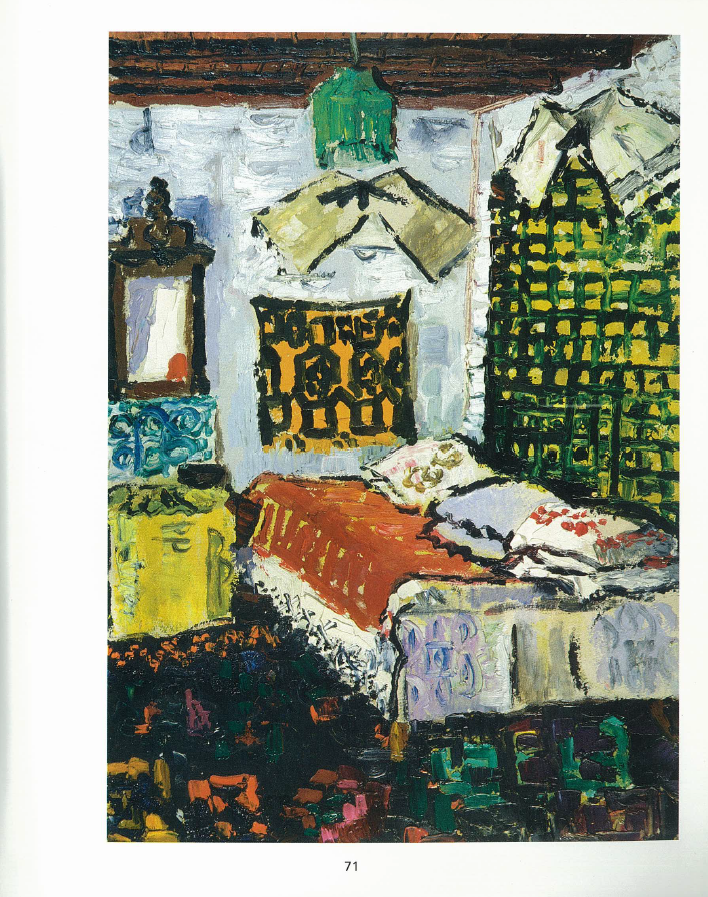
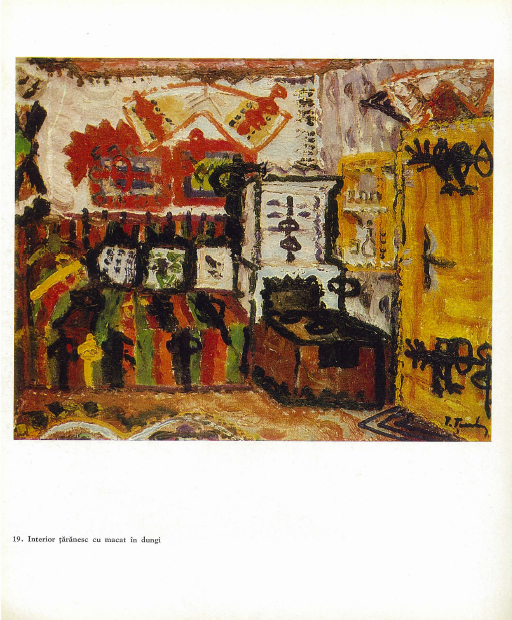
Ion Țuculescu's first interiors appear around 1942, approximately at the same time when fewer and fewer still lifes began to be known in his work. Therefore, it seems that the artist works in interconnected but also well-defined cycles, opting to transfer his creative searches from one thematic to another. His tours of European museums in the late '30s will bring Țuculescu face to face with the famous "Room in Arles" painted by Vincent Van Gogh. Starting from these considerations, we could discern, in the work "The Painter's Workshop" produced in 1942, the source of creation that laid the foundation for the entire cycle dedicated to interiors. However, Țuculescu's creative sap will also be extracted from indigenous motifs, through his association with folklore. The series of peasant interiors anticipates the deeply folk period in the artist's work, the famous rapeseed fields and the totemic period. In the present work, clearly demarcating itself from the rest of the composition through its unique chromatics, the green rug becomes the central theme of the work. Țuculescu carries out a complex exercise here, from which a deliberate excess of chromatic exuberance emerges. He opts for intense shades and strong contrasts, using predominantly shades of blue and yellow. The perspective the artist breaks down into plastic motifs includes the three walls of the room filled with exuberant stylistic details. On the right side of the composition we find the bed, rendered in striking shades of yellow, into which Țuculescu has inserted a few reddish waves. The same ripples will spill over to the pillows placed on the bed, above the central element of the work: the rug.
In illustrating the rug, the artist dwells on the chromatic tones that visually evoke it. From the raw green, set directly on cardboard and up to the additions of black or white, the painter perfects his chromatic palette in relation to the other elements. On the left side, we find the window crowned by the presence of flowers. The nocturnal blue that resides in the window pane, the red and shades of pink that emerge from the middle of the green leaves of the plants, or the yellow towel adorned with cherry flowers gently introduce us to the lyrical atmosphere of the creation. Centrally, the back wall is decorated with traditional ornaments specific to the area where the painter carries out his activity. The multiplication and diversification of the towel invoke an archaic world and also become a sacred archetype of the ancestral village. These will be predominantly illustrated in warm tones, ochre and orange. The indispensable Oltenian vessels are confined in the same plane, directly on the floor. The artist opts for earthy tones and thus for a closer connection to traditions. If in the upper plane the bluish-white tones predominate in the rendering of the background, the lower plane is rather furrowed by dark tones, of brown and red. The lyric strength will take the form of contrasting and decorative color discharges, transposed as traditional signs that contribute to the creation of the atmosphere. Richly decorated, the artist's room invites us to penetrate deeper into his intimacy and opens the way for deciphering his inner turmoil. Țuculescu will take over, in his work, decorative elements of popular inspiration that present an adjacent character, being necessary for the compositional homogenization. The meanings of the Oltenian bark reside now in magical formulas, long prefigured by the ascetic artist of the image.
For clarifications regarding the bidding procedure, hammer price costs, guarantee, payment, and collection terms for the winning lot, we recommend carefully reading/re-reading the Bidding Regulations.
For additional information regarding the lot and the auction, please contact the Art Consultants Department.
By choosing "Accept all cookies" you agree to the use of cookies to help us provide you with a better user experience and to analyse website usage. By clicking "Adjust your preferences" you can choose which cookies to allow. Only the essential cookies are necessary for the proper functioning of our website and cannot be refused
Cookie settings
Our website stores four types of cookies. At any time you can choose which cookies you accept and which you refuse. You can read more about what cookies are and what types of cookies we store in our Confidentiality Policy.
are necessary for technical reasons. Without them, this website may not function properly.
are necessary for specific functionality on the website. Without them, some features may be disabled.
allow us to analyse website use and to improve the visitor's experience.
allow us to personalise your experience and to send you relevant content and offers, on this website and other websites.