
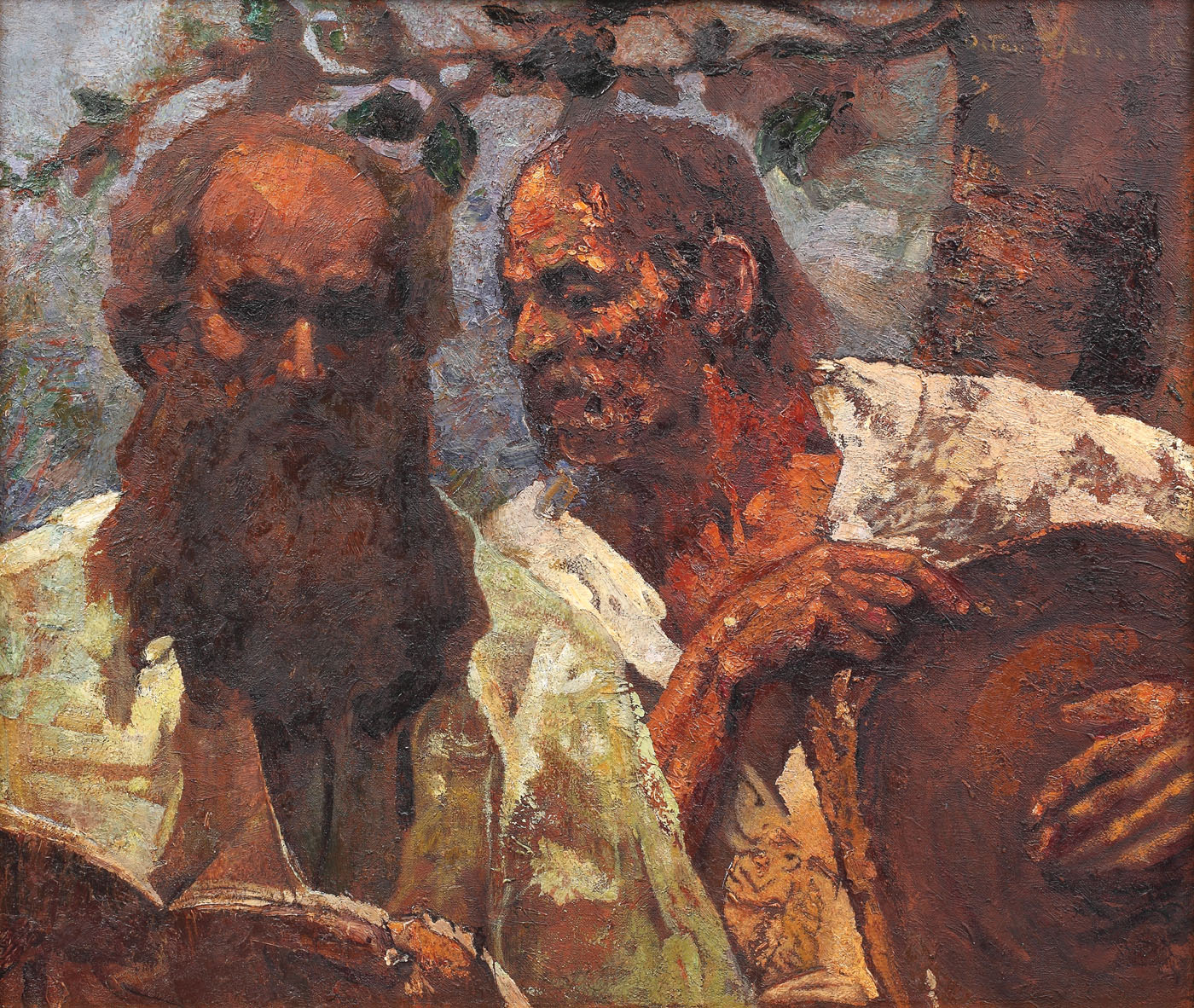
32. The Peasant's Confession (Composition with the Painter's Self-Portrait)

The photos of the lot are informative and indicative, and cannot provide a highly detailed view of the object from all angles. We recommend a careful physical inspection of the lot before bidding.

32. The Peasant's Confession (Composition with the Painter's Self-Portrait)
1872, Corni, Botoșani - 1944, Bucureşti

Estimate:
EUR 15.000 - 25.000
Not sold

References

COMAN Anton, ”Octav Băncilă”, Editura de Stat pentru Literatură și Artă, 1954 DREPTU Ruxandra, ”Băncilă”, Ed. Meridiane, București, 1987

oil on canvas, 82 x 96 cm, 96x82, signed upper right, in ochre, "Octav Băncilă"

For Octav Băncilă, portrait was a genre that he approached throughout his career with a passion explicable precisely through his character, a quality easily revealed by an artistic product defined by the multitude of interrogated human types. Whether he was interested in portrait in a symbolistic spirit - at the beginning of his career, during the German period – or he painted the human face while being interested in the physiognomic features or passionate about the picturesque appearance of his models, Băncilă shaped in his 40 years of practice a very specific structure of the pictorial means necessary for representative portraits. So well-known, the investigated human types reveal an artist interested not just in the plastic side, but also in the appearance of the simple man in the visual work. The peasant, to whom he felt a deep attachment, the Jew - especially the traditional, picturesque one in the urban imagination of Iaşi in the first decades of the 20th century - or the gypsy and the nomad kindled strong passions materialised in a true portraitist body of work. Beyond its simple appearance, the character painting is sometimes loaded with spiritual considerations, as we can easily discover in this work. The double portrait, in fact a peasant face joined by the self-portrait on the left side of the painting, impresses both through the picturesque aspect of the composition and through the artist's reconsideration of himself and of the other. In peasant’s clothes, with his head uncovered - reminding of a certain social status - but with the book in his hand, Băncilă comes closer to the cultivated peasant type, thus encompassing an archetype. (I.P.)

For clarifications regarding the bidding procedure, hammer price costs, guarantee, payment, and collection terms for the winning lot, we recommend carefully reading/re-reading the Bidding Regulations.

For additional information regarding the lot and the auction, please contact the Art Consultants Department.
SESSION
Tue, 6 February 2018 19:30

Similar lots