


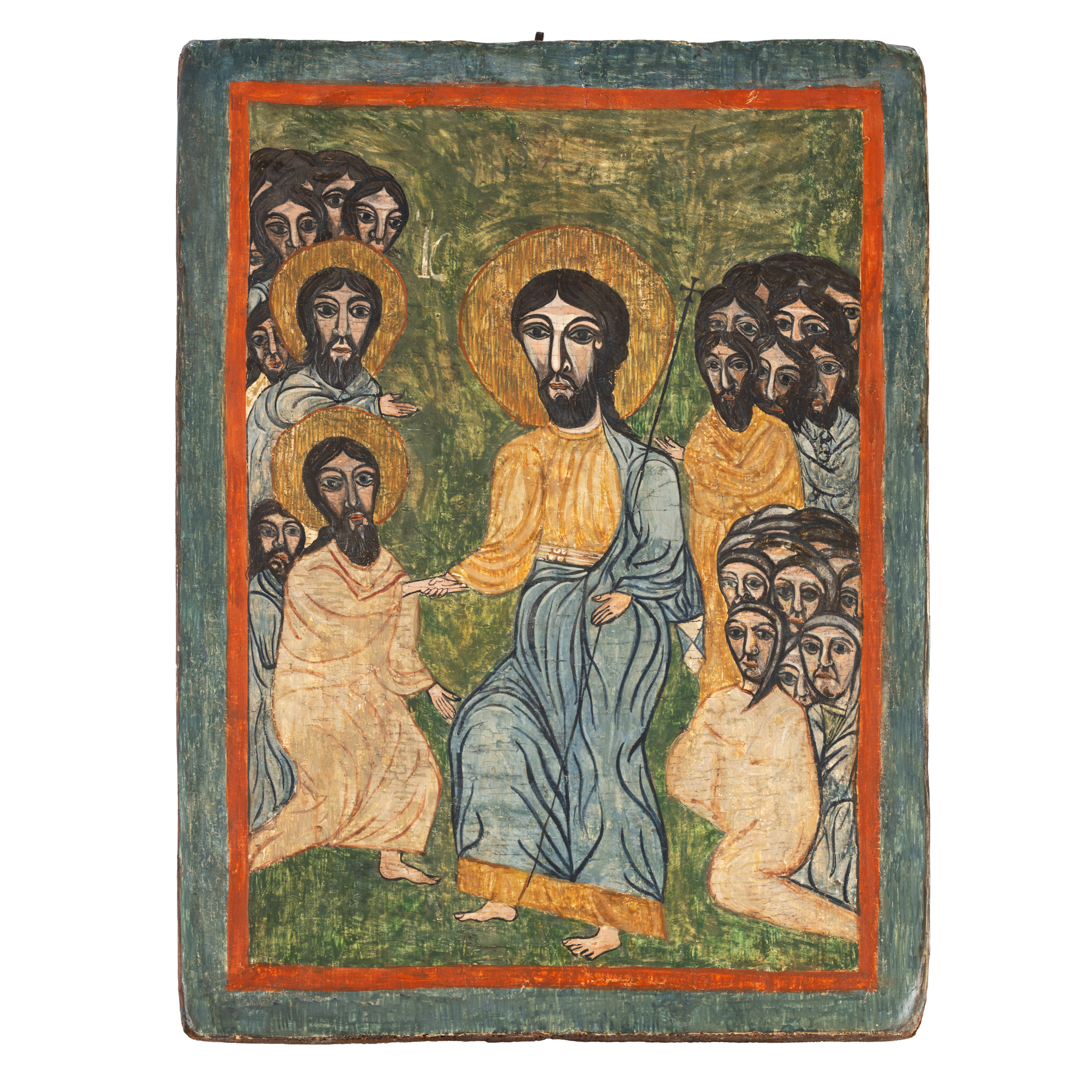
11. "Icon on Wood, 'Resurrection of the Lord', Transylvanian school, workshop from Maramureș, 18th century"
The photos of the lot are informative and indicative, and cannot provide a highly detailed view of the object from all angles. We recommend a careful physical inspection of the lot before bidding.
11. "Icon on Wood, 'Resurrection of the Lord', Transylvanian school, workshop from Maramureș, 18th century"
Starting price:
EUR 1.400
Not sold
tempera on wood, 57 x 40 cm
Identification elements of an iconographic and stylistic order: The icon represents a scene from "The Passion of Jesus" specifically "The Resurrection of the Lord" in the form "Descent into hell". The icon's background is green, at the top, Jesus Christ, depicted standing, forms the axis of symmetry of the composition. He is flanked on the right and left by groups of "righteous people", depicted in choral perspective, and the same symmetry is reflected in the lower plane, where people in hell are grouped similarly. The moment of resurrection to eternal life is highlighted by the resurrection of Adam, whom Jesus symbolically raises from death, and on the opposite side is Eva, kneeling. The faces of the characters are slightly differentiated: they have large heads, with the oval of the face sharp, and the features are drawn with thick strokes, through a synthetic, but expressive drawing. The same design is found in the rendering of the folds of the clothes, painted in two colors, with ocher and sky-blue in flat shades, little valued. The simplification of the compositional scheme, the predominantly graphic execution and the increased expressiveness, along with the power of suggestion, are characteristic features of the Transylvanian painting recalling the first icons preserved in the Christian East.
Identification elements of a technical order: The icon is made on a wooden panel, using the tempera technique, which ensures a uniform application of colors. Technical details - such as the use of two-tone colors and the application of glaze - indicate a careful execution, specific to this period.
Conclusions: The work highlights an expressive and simplified interpretation of the Passion scene, reflecting the style of Transylvanian painting. Iconographic and stylistic elements, such as the compositional symmetry and the graphic rendering of the faces and clothing, recall the first icons in the Christian East, and the technical execution on a wooden panel is characteristic of the era (A.D.).
For clarifications regarding the bidding procedure, hammer price costs, guarantee, payment, and collection terms for the winning lot, we recommend carefully reading/re-reading the Bidding Regulations.
For additional information regarding the lot and the auction, please contact the Art Consultants Department.
SESSION
Brought to you by
Similar lots
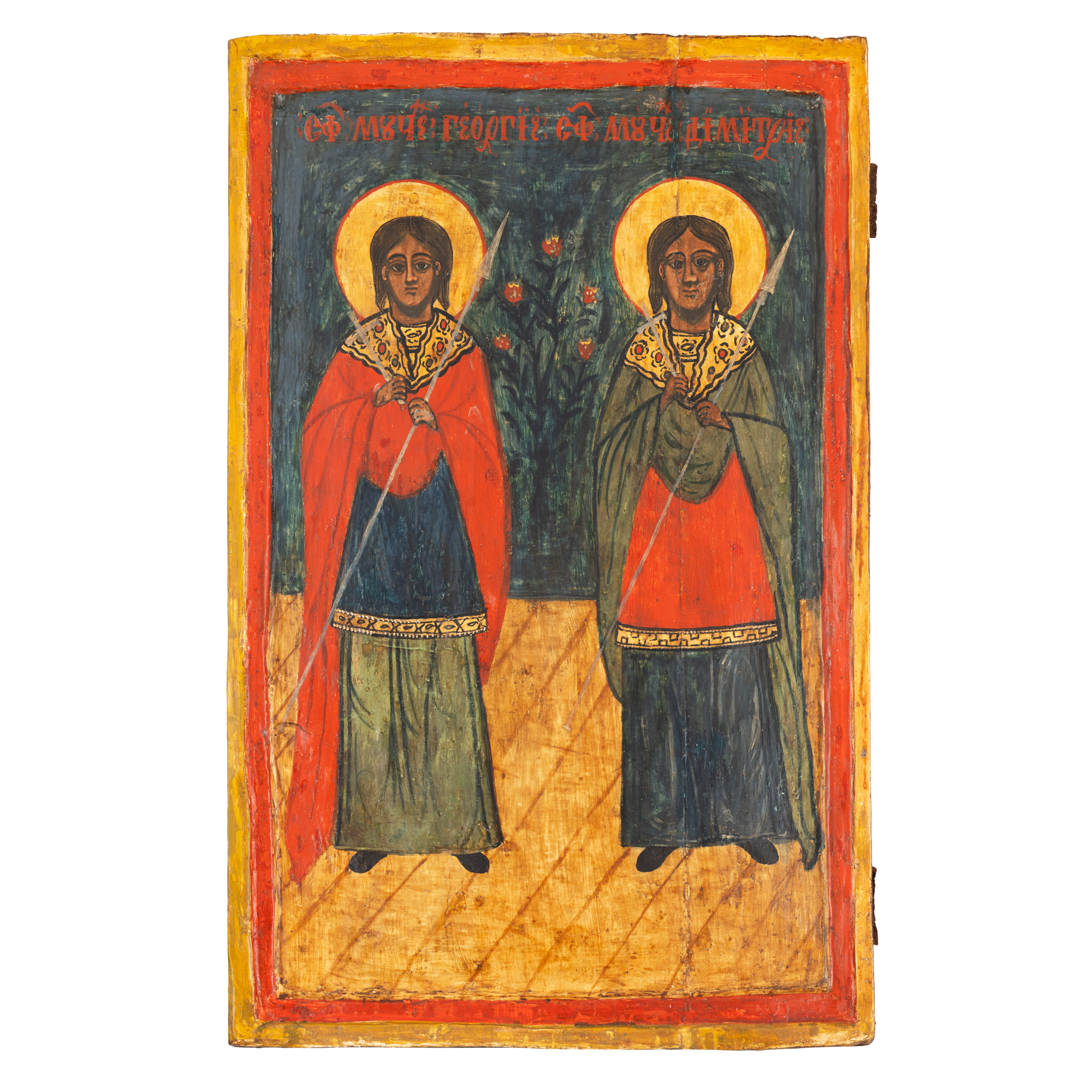
33. "Imperial Icon on Wood, 'Saint Martyrs George and Dimitrie', post-Brancoveanu school, possibly workshop from Banat, end of XVIII century"
Starting price:
EUR 1.500
Sold
EUR 1.500
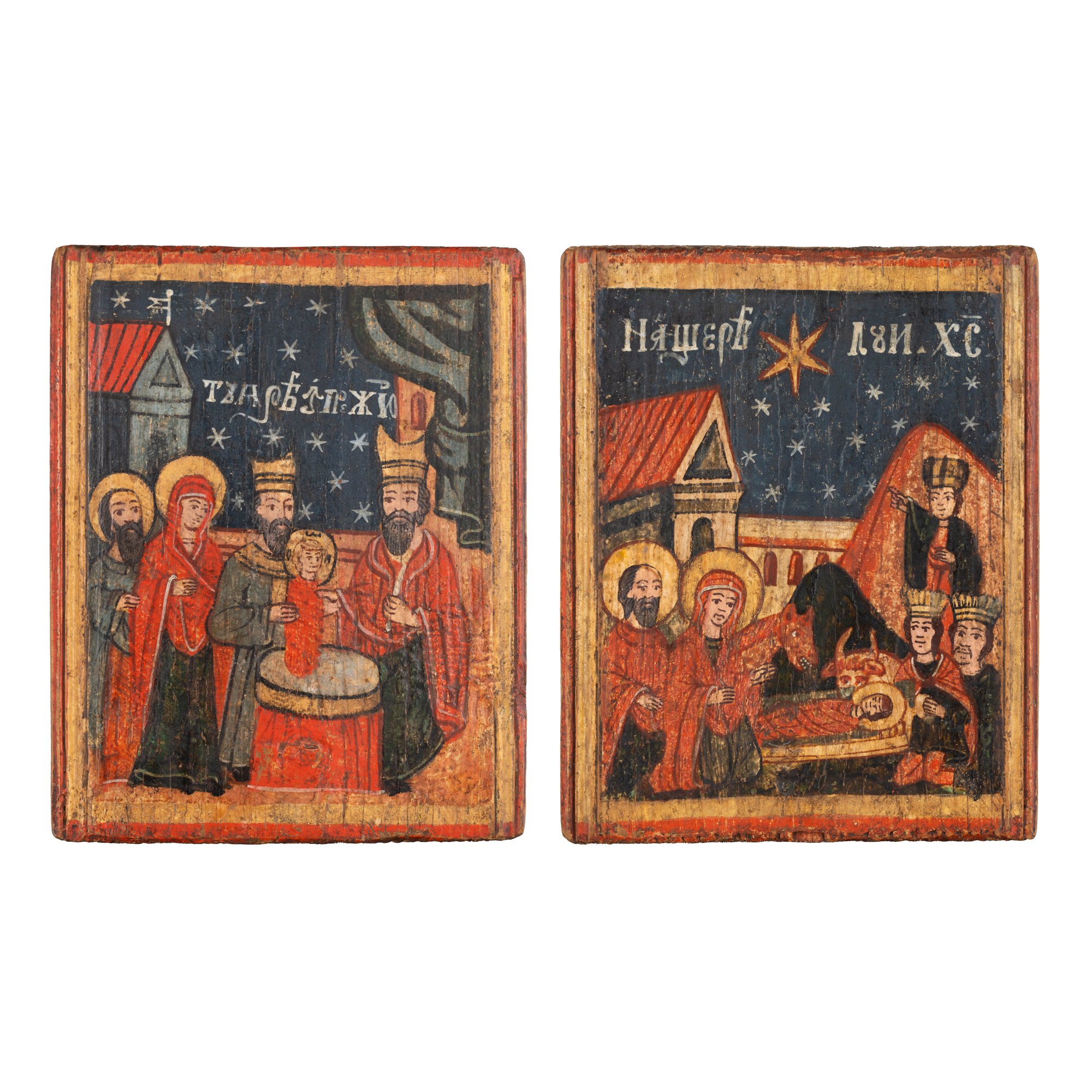
59. Double Feast Icon, "The Nativity of the Lord" and "The Meeting of the Lord", Transylvanian School, end of the 18th-beginning of the 19th century
Starting price:
EUR 250
Sold
EUR 800