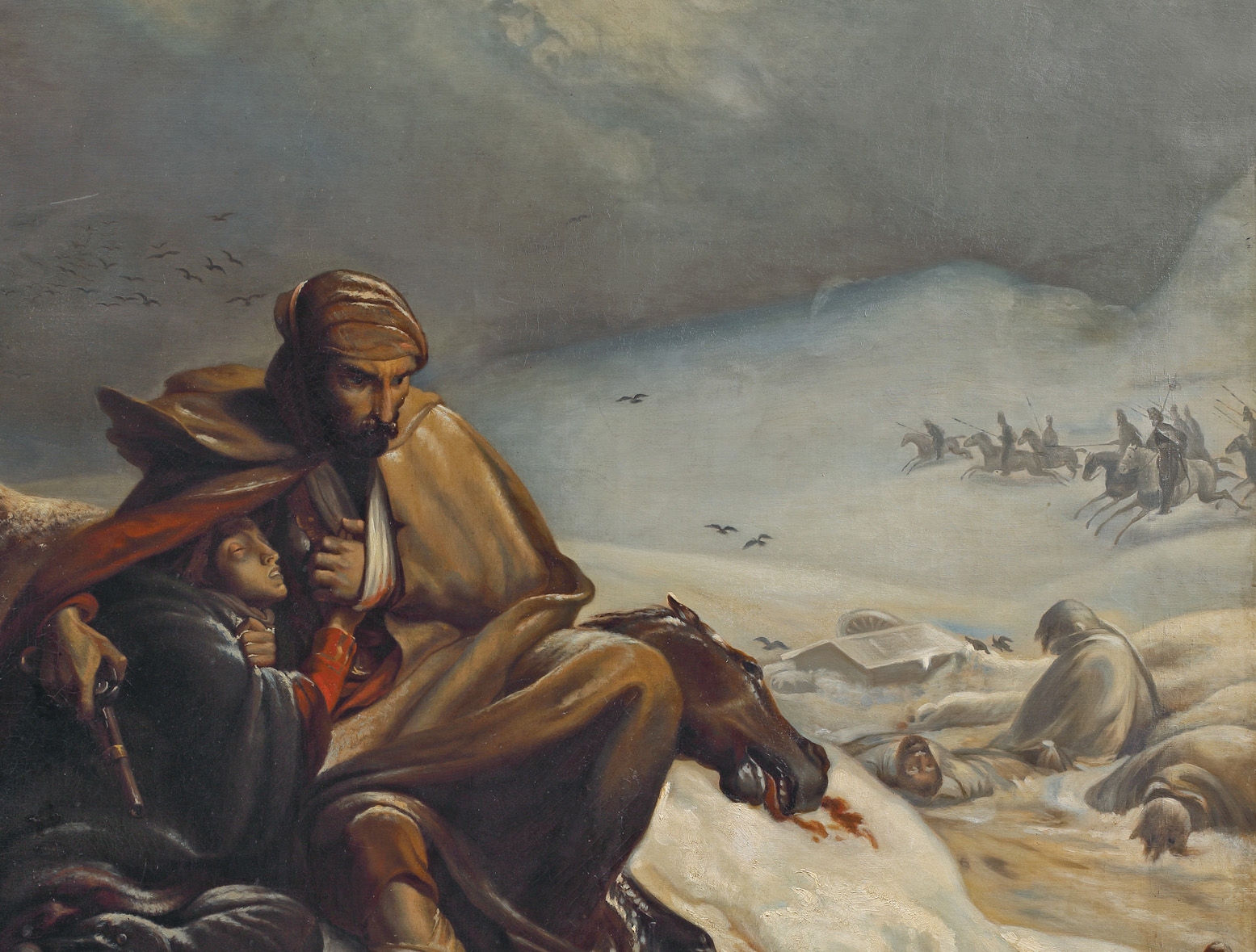
120. Withdrawal from Russia [1882]
The photos of the lot are informative and indicative, and cannot provide a highly detailed view of the object from all angles. We recommend a careful physical inspection of the lot before bidding.
120. Withdrawal from Russia [1882]
1844, Dobreni, Neamţ - 1920, Iaşi
Estimate:
EUR 2.500 - 3.500
Sold
EUR 4.000
oil on canvas, 89 x 119 cm, signed, dated, located and noted bottom right, with brown, "C.D. Stahi, 1882, Iassy, Philippoteaux"
Stahi studied in an extremely rigorous academic environment, and followed an upward path, starting with the apprenticeship alongside a church painter, and culminating with teaching in the Iaşi School of Fine Arts. He studied with Gheorghe Bardasare Panaiteanu in the capital of Moldavia, and afterwards he set off to Munich, just like the vast majority of his colleagues, for a better professional development. C. D. Stahi is, alongside Em. Panaiteanu Bardasare, the first Moldavian drawer-engraver and "honourable painter" contemporary with Grigorescu. The quality of Stahi's drawing was noticed by art historians (Gh. Oprescu, 1945), being outpaced only by Grigorescu's drawing. His most successful works start from a masterpiece that impressed him, especially those representing intimate, interior scenes. This type of subjects were convenient for Stahi's "slow" working style, in a constant rhythm and without any rush, incongruous with the perpetually altering motifs. A tradition of academy schools, taken over from the French and perpetuated even in Romania, is the reproduction of renowned artistic themes.
Phillippoteaux did not experience the withdrawal from Russia, and he probably took his inspiration from survivors' dreadful testimonials, such as those of Lieutenant Chevalier or Montesquiou. The Russian campaign is one of the infamous events of Napoleonic history. Starting from 1807 and from the signing of the Tilsit Treaty, Russia was a part of the continental blockade imposed by France. Napoleon's politics has the purpose of weakening the United Kingdom by hindering its entire commerce with the European continent. As Tzar Alexander no longer respected his commitments, in 1812 Napoleon gathers almost 500,000 men and starts a campaign against Russia.
The Russian campaign episode represents the chaos and the horror amongst soldiers during the withdrawal from Moscow. The two men in close-up are overwhelmed with cold, and the lack of food and the injuries they went through were draining their strength. Not even their uniforms and equipment can distinguish the regiment in which they serve. Being exhausted, they can no longer fight; they wait for death, which appears under the guise of the Kazakh riders in the background.
For clarifications regarding the bidding procedure, hammer price costs, guarantee, payment, and collection terms for the winning lot, we recommend carefully reading/re-reading the Bidding Regulations.
For additional information regarding the lot and the auction, please contact the Art Consultants Department.
SESSION
Similar lots