


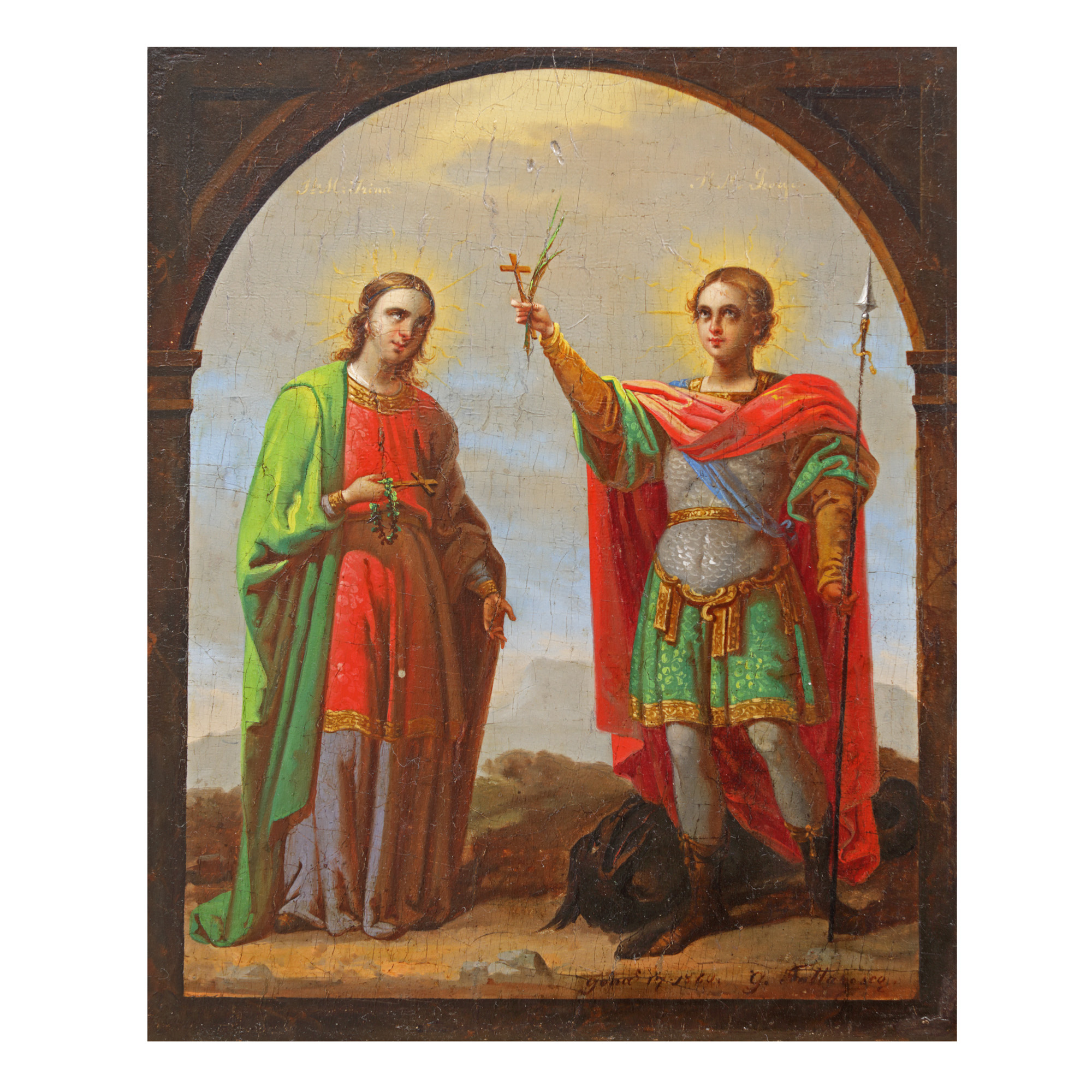
103. Saint Martyr Irina and Saint Martyr George [1860]
The photos of the lot are informative and indicative, and cannot provide a highly detailed view of the object from all angles. We recommend a careful physical inspection of the lot before bidding.
103. Saint Martyr Irina and Saint Martyr George [1860]
1818, Focşani - 1894, Bucureşti
Estimate:
EUR 2.500 - 3.500
Sold
EUR 5.500
References
M.I.A.M.B, "Gheorghe M. Tattarescu", Alcor Edim Pex srl Publishing House, Bucharest, 1994. NANU, Adina, "Gh. Tattarescu", State Publishing House for Literature and Art, Bucharest, 1955. WERTHEIMER-GHIKA, Jacques, "Gheorghe M. Tattarescu – Un pictor romîn și veacul său" ("Gheorghe M. Tattarescu - A Romanian painter and his time"), State Publishing House for Literature and Art, Bucharest, 1958.
tempera on wood, 32 x 26 cm, signed and dated bottom right, in brown, "genar 17 1860 G. Tattaresco"
Research information
The painter's artistic debut coincides with his learning the craft of painting at the age of nine. In 19th century, in Wallachia, painters were mainly church painters. Their main purpose was to respect the canons in order to pass on the images painted on the walls of places of worship. Romanian church art has not remained impassive to the influences of European artistic currents. Depending on their location, Romanian churches or monasteries have Gothic, Baroque or Neoclassical highlights. Also in the 19th century, one can observe an increased interest in portraiture, an interest that we will also identify in Tattarescu's work. Cristina Panaite affirms, in the volume dedicated to the artist: "Tattarescian creation is - up to a point - similar to the very evolution towards modernity of Romanian art in the last century". During his studies in Italy, Tattarescu analyses and reproduces the works of great artists and turns his attention to landscape, thus creating among the first landscapes in Romanian art. He tackles historical subjects and demonstrates an activist spirit through his involvement in the 1848's revolution, an action that will lead to portraits of revolutionaries such as Gheorghe Magheru and Golescu brothers. He dedicates a large part of his work to religious painting: he paints icons, churches and monasteries. His ecumenical language appears in the form of a mixture of academism learned in Italy and Byzantine painting. Byzantine iconography was normatively considered to conform to the canons imposed by Orthodoxy. In 1859, he became a founding member of the Academy of Art in Bucharest and devoted himself more to teaching.
PROVENANCE
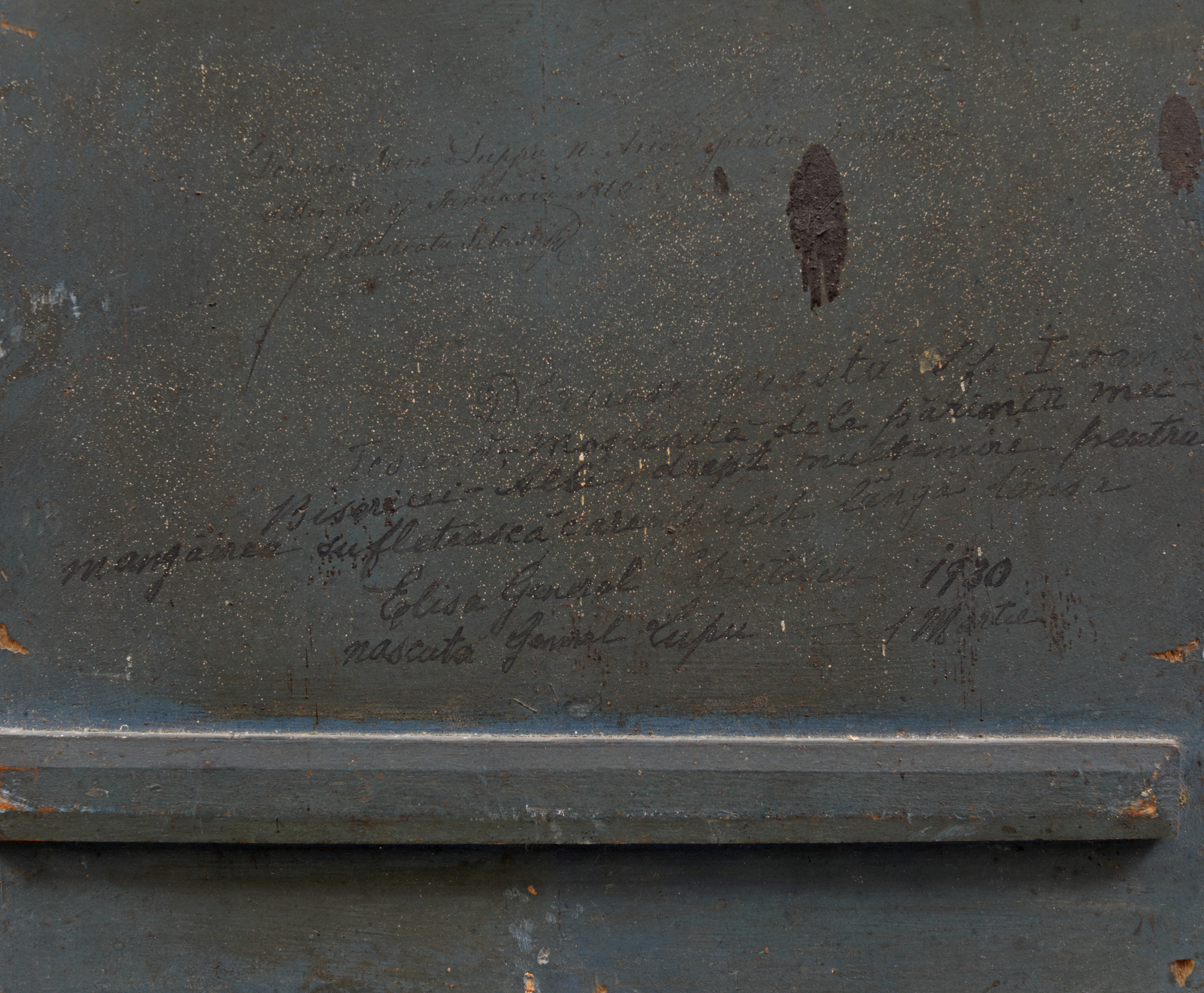
According to the inscriptions on the reverse of the icon, for the first time in a public auction, we can trace the history of an icon from the time it was made and left the painter's workshop to the present day. Therefore, on January 17, 1860, the painter Gheorghe Tattarescu signed the icon, and on January 27 it is offered by Calistrat Sebas to Mrs. Irene Lupu, born Arion. On March 1, 1930, Elisa General Cristescu, born General Lupu, offers the icon to the White Church from TârgÈoru Vechi, Prahova county. According to the current owner, in the 1970s the parish priest of the church, most likely, offered it to Dr. Georgescu Constantin who worked in Prahova county, in gratitude for the medical services provided. In 1982, the piece was inherited by the current owners.
In a neoclassical exterior gallery, which gives the icon a stylised frame, and against a background dominated by the cloudy sky, the two saint martyrs are depicted. Saint Martyr Irene is depicted standing, dressed in a blue dress and red tunic, embroidered with gold at the neckline and sleeves and with braid at the lap, wearing a green draped cloak on her back. In his left hand he holds the insignia of his martyrdom (cross and laurel wreath). Saint George is depicted standing looking to the left. The character wears soldier cloths, with a cloak draped over his shoulders and holding a cross in his right hand, raised above his head, and a spear in his left hand. The right foot is glued to one of the legs of the wounded dragon.
On the reverse of the icon we find the following inscriptions: "To Mrs Irene Luppu n. Arion for ... (?) / January 27, 1860 / Calistratu Sebas... (?) central position; "I give this Holy Icon / Icon inherited from my parents / To the White Church, as thanksgiving for / the soul comfort that . . . (?) beside her / Elisa General Cristescu / born General Lupu: 1930 / March 1".
For clarifications regarding the bidding procedure, hammer price costs, guarantee, payment, and collection terms for the winning lot, we recommend carefully reading/re-reading the Bidding Regulations.
For additional information regarding the lot and the auction, please contact the Art Consultants Department.
SESSION
Brought to you by
Similar lots
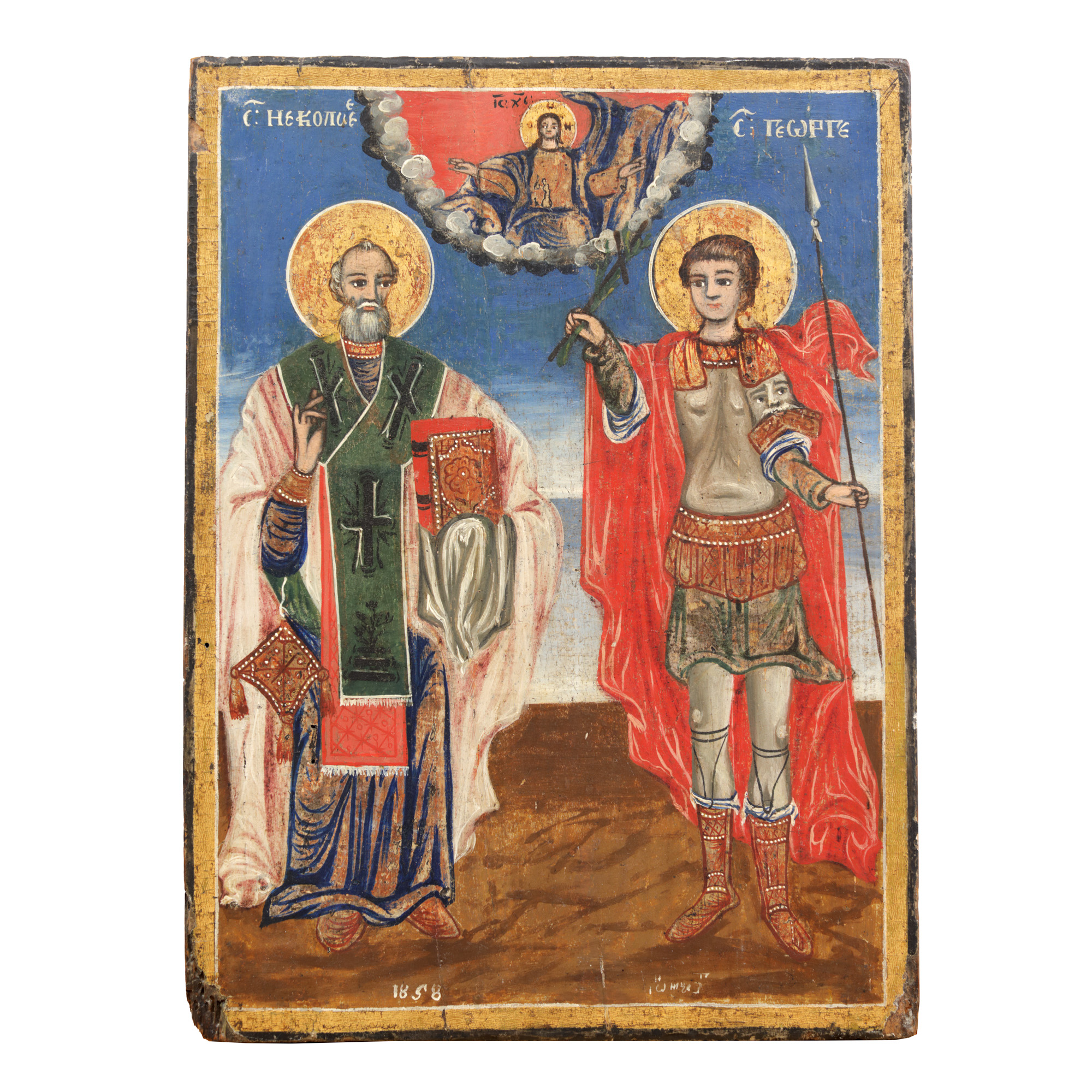
111. Icon on wood, "Saint Nicholas and Saint Gheorghe", housepainter Ioan Niță, 1858
Starting price:
EUR 500
Sold
EUR 2.250
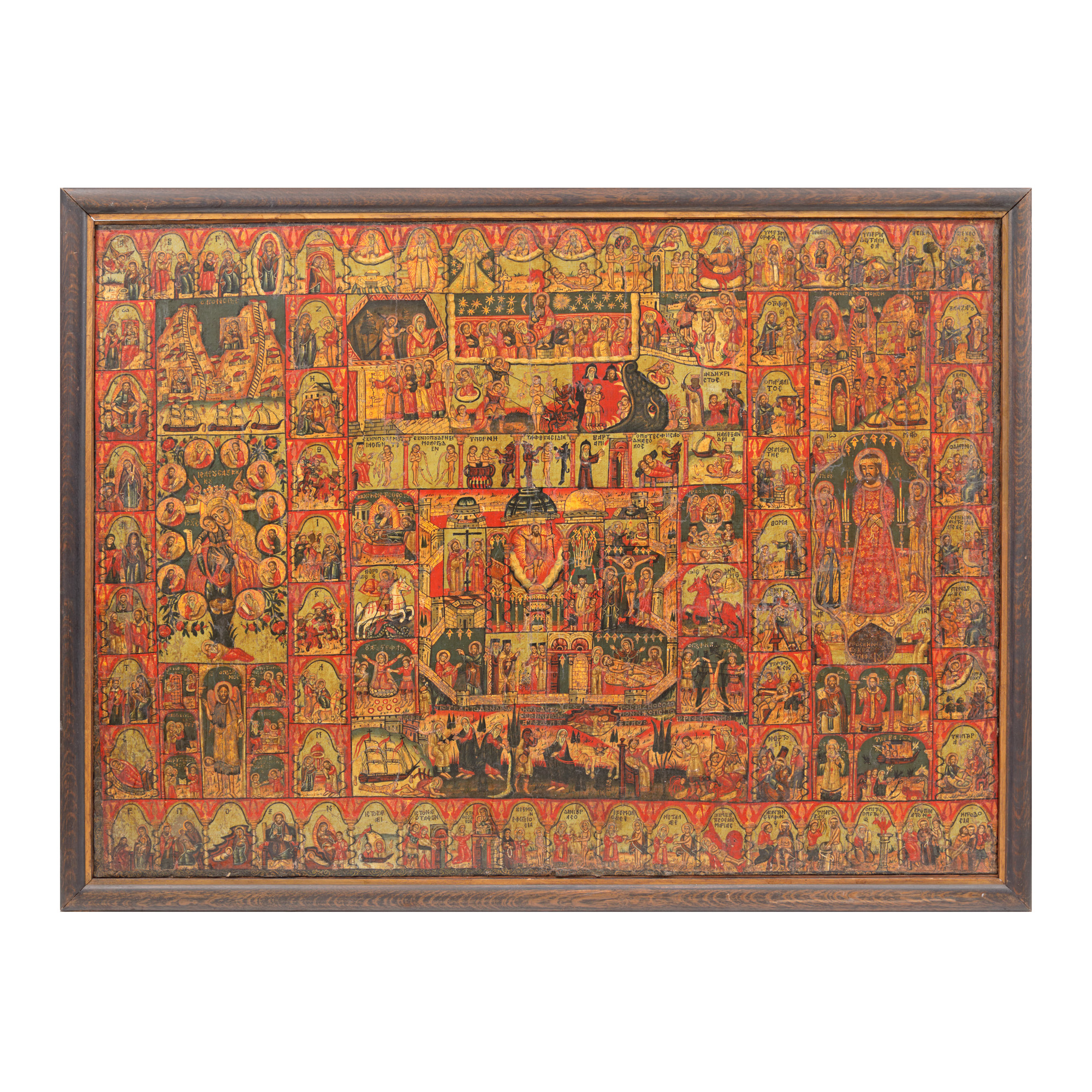
64. Pilgrimage icon, "Jerusalem Fortress", mid-19th century, rare piece, collectible
Starting price:
EUR 2.000
Sold
EUR 5.000
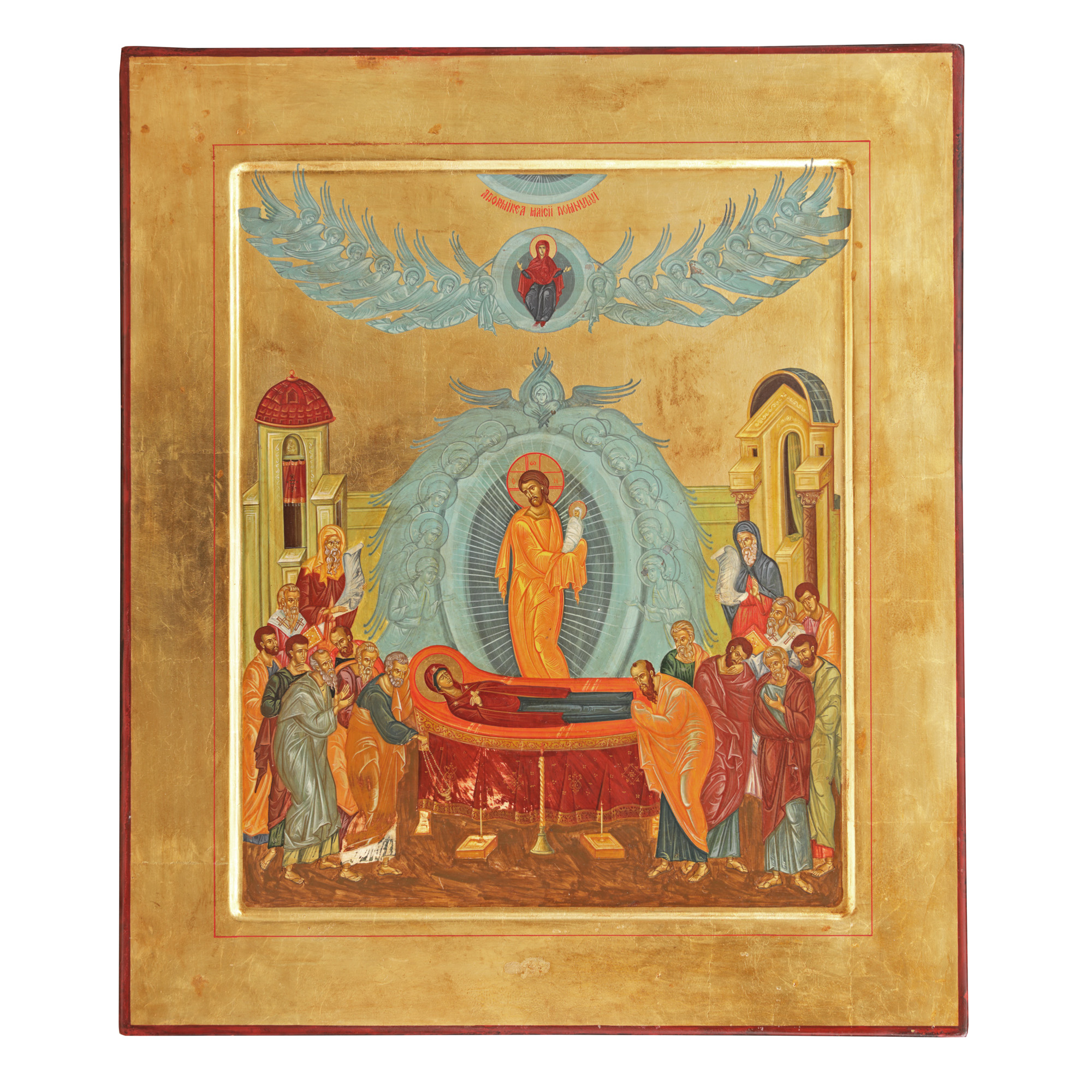
108. Emperor icon on wood, "The Assumption of the Virgin Mary", Romanian school
Starting price:
EUR 800
Sold post auction
EUR 1.000