The photos of the lot are informative and indicative, and cannot provide a highly detailed view of the object from all angles. We recommend a careful physical inspection of the lot before bidding.
"Paul Neagu" Catalog, National Museum of Art of Romania, Bucharest, 1996.
"Paul Neagu" Monograph, The Paul Neagu Estate (UK), JRP editions, 2023.
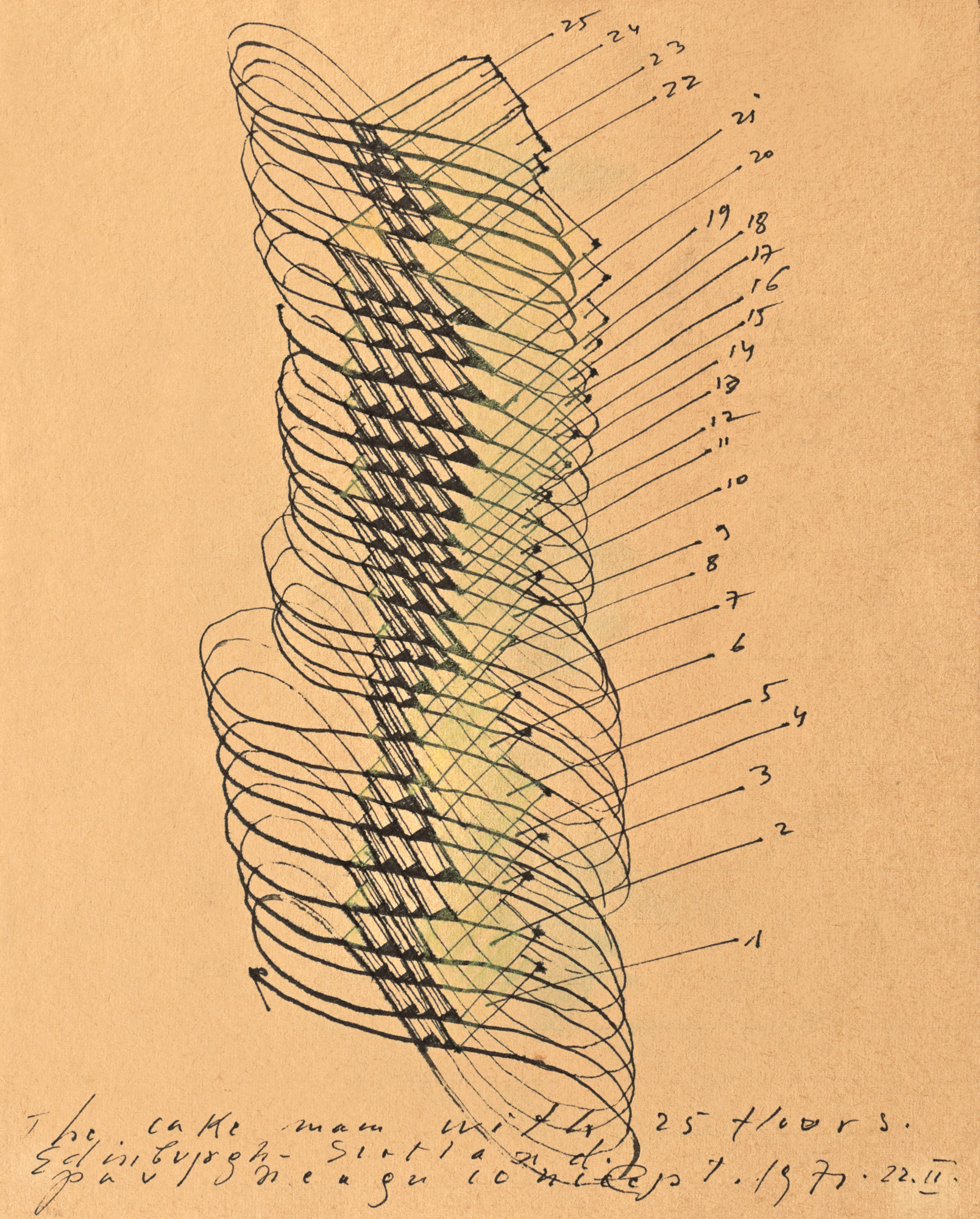
signed, dated, titled and located at the bottom center, in black, "Paul Neagu, concept, 1971.22.II, The Cake Man with 25 Floors, Edinburgh, Scotland", 20 x 16 cm, Ink and watercolor on paper glued to canvas
Paul Neagu's work represents a random amalgamation of lines, shapes, and color spots and is usually grouped into broad cycles, which the artist attributes with specific names and profound meanings. The artist's philosophical concerns and searches sometimes take on the tones of an ordered chaos, revealing his interest in the division between figurative and decorative. Hesitations and progress merge harmoniously and blend hermetically in his works. Neagu extract from his study on fractal and generative geometry the most flexible forms, with extraordinary plastic potential: the triangle, the rectangle and the circle, which he transposes, one by one, in the form of the cone, prism or sphere. A multivalent artist, he demonstrates, like many sculptors before him, a special inclination towards drawing. The drawing is, for Neagu, a tool both in painting and in sculpture. The attitude he adopts in front of art is obviously agnostic. He prefers to appeal to consciousness and to remove any trace of esotericism from his work, yet leaving room for multiple interpretation possibilities. From the very beginning, the project of the present work - "Cake Man"- was conceived as a happening or a performance, meant to exist as a participatory activity for its audience. Conceived as a ritual, the action of this project could approach a diverse chronotope, having no significant physical or temporal constraints. The premiere took place in 1971, simultaneously: at the Sigi Krauss gallery in London (where the author himself was present) and at his workshop in Bucharest, where Julian Mereuță (artist and art critic) was present. Over the years, the action was repeated in various forms, the most recent of which is the event within the Art Cologne space, where "Cake Man" was nothing more or less than what the title suggests: a humanoid installation made from pieces of cake, thus an edible body. In 1971, the audience in London was greeted in the gallery by the smell of freshly prepared waffles, welded together with chocolate glaze, to result in the anthropomorphic shape dreamed of by the artist. This form was then divided and spread to the audience, who thus came into direct contact with Neagu's tangible art. Thereby, the artist's thought-out act's finality will be questioned, and a multitude of new epilogues will be suggested. Through this performance, Paul Neagu reiterates his interest in the deconstruction and reconstruction of the human body and the relationship between part and whole within an organism with reference to the formation of a collective (the present audience), actively contributing to the artist's vision. The project opens the way for a new series of research undertaken by the author on human anatomy - he will create a cycle of sketches and studies where he minutely analyzes various aspects of the human body, with accents on the parts that arouse his interest the most (we repeatedly find the heart, lips, ear, hands, sole of the foot or the skull). Grouped under the concept of "anthropocosmos", these studies and cellular divisions laid the foundation and even facilitated the later performance, but they did not cease to appear after the physical actions were exhausted in the exhibition spaces.
For clarifications regarding the bidding procedure, hammer price costs, guarantee, payment, and collection terms for the winning lot, we recommend carefully reading/re-reading the Bidding Regulations.
For additional information regarding the lot and the auction, please contact the Art Consultants Department.