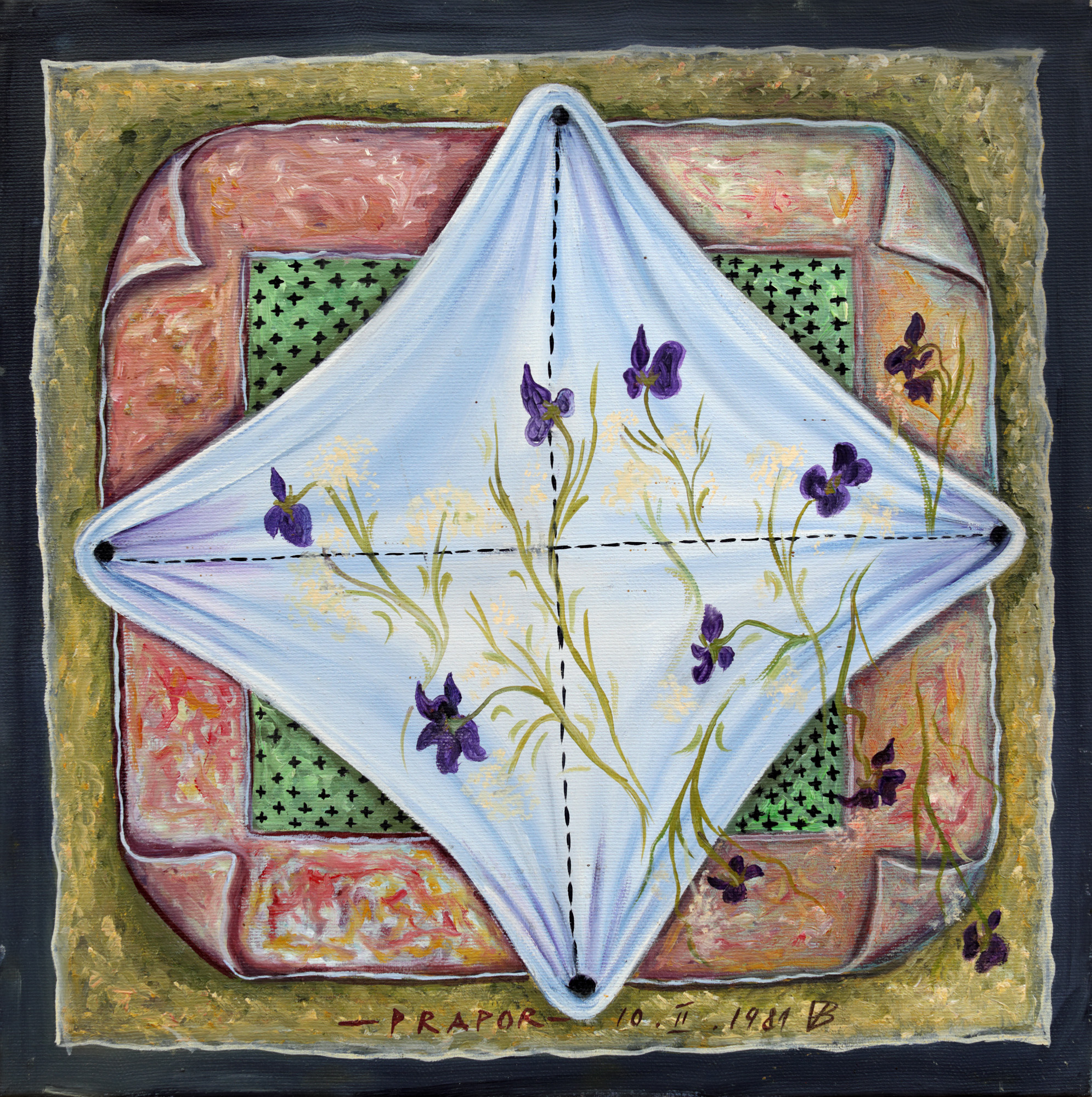

52. Flag [1981]

1938, Bucureşti - 2000, Paris

Estimate

EUR 1.200 - 1.800

Sold

EUR 6.000

Session

Tue, 20 February 2024 19:00

Brought to you by

Concerned with the sanctification of the pictorial act, Horia Bernea introduces ecclesiastical motifs in his work, but at the same time aims at sanctifying ordinary motifs. His great challenge is to juxtapose symbols that look seemingly impossible to combine. He produces a series of writings (in the form of notebooks/diaries) in a deeply philosophical manner, where he expresses his personal vision of art and the world. These writings summarize how his entire work can be decoded. His strokes are incisive metaphors, which reach deep into the canvas. However, we find the essential uncertainty and mystery - an element of knowledge - that Bernea often used to express the natural unity in his paintings. His work transcends mere appearance, possessing a spiritual character and often raising issues of consciousness. The artist deciphers, through painting, the essential uncertainties of everyday life and tackles nature series with a mathematical skill. His creation aligns with both new realism and conceptual expressionism. "The prapor was first called Piece de transition, then Crossing, then Mark for infinity, subsequently a series of "operational images"." , the artist declared. In his work's economy, the prapor was created around the '70s. Initially, it was constructed on canvas and propped on two perpendicular crossed metal rods. This "cross" was the skeleton of Bernea's construction and was meant to support the canvas span. As a conceptual object, with a permanent presence, the prapor can be understood as a spiritual experience. The cycle dedicated to this subject - the mark of infinity - captures Horia Bernea's attempt to approach his own art methodically, spiritually, and scientifically. A work constructed in the same way as the current piece, but of considerably larger dimensions (130 x 130 cm), is in the collection of the National Museum of Contemporary Art and was created in the same period (1980-1981). We find in both prapors a central element that divides the canvas into several planes. We identify chromatic and stylistic borrowings - in the second plane, which supports a plethora of small joints outlined in black strokes, against a green background. Possessing both an abstract and a tangible content, the prapor becomes a sphere for the coagulation of spiritual efforts, often expansive. Perhaps most important - the series proposed by the artist mediates his journey in perfecting asceticism.

References

"Horia Bernea", National Museum of Art of Romania. Department of Contemporary Art, Bucharest, 1997. The Monograph "Horia Bernea", Noi media print Publishing, 2008. "School of Poiana Marului", Museum of Art Brasov Publishing, 2013.

Dimensions

width 35 cm, height 35 cm

Description

oil on canvas, signed, dated and titled centrally at the bottom, with violet, "H.B., 10.II.1981, Prapor"

Dating

1981

ADDITIONAL INFORMATION

For clarifications regarding the bidding procedure, hammer price costs, guarantee, payment, and collection terms for the winning lot, we recommend carefully reading/re-reading the Bidding Regulations.

For additional information regarding the lot and the auction, please contact the Art Consultants Department.

Similar lots