


Fotografije parcele su informativne i indikativne te ne mogu pružiti vrlo detaljan prikaz objekta iz svih kutova. Preporučujemo pažljiv fizički pregled parcele prije licitiranja.
“…Nicolae Dărăscu reflects in his canvases the vigour of a positive, manly character. His paintings are organised in a logical, daring manner, with no exception – with an energy harnessed by tight discipline, which allows no mistake in the realm of fantasy and does not accept concessions to sensitivity. Partially faithful to Impressionism, in Dărăscu’s art we can feel his exclusive concern for colour and light.” (N.N. Tonitza, “Two great landscape painters…”, Universul Literar, 10 April 1927, apud Catalogue of the "Nicolae Dărăscu" Retrospective Exhibition, Art Museum of the Socialist Republic of Romania, Bucharest, 1966)
A representative artist of the interwar period, Nicolae Dărăscu felt attracted by two great art movements: Impressionism and Neo-Impressionism. The former offered him the chance to express himself through colour, a need that existed in a certain side of Dărăscu’s personality, while the principles of the latter corresponded to his tendency to subordinate the impressions of a precise rule. From the very beginning, Dărăscu’s works place the painter in the realm of landscape themes, a genre that brought his well-deserved establishment in the history of Romanian art. Focusing on a few composition schemes, Dărăscu remained faithful to nature as a subject throughout his fifty years of artistic activity, the variety of his landscapes being closely linked to the chromatic palette and the atmosphere he creates in each of them. Songs of the Romanian space, Dărăscu’s landscapes are built with wide touches, with slight chromatic passages, focusing light in a few centres of colour, by way of vivid harmonies. Paris and Provence, later inspirations, come to life in works where chromatic harmonies are replaced by vigorous coordinations of bright colours.
The years 1920-1944 identify with the second period of creation – out of the three – when Dărăscu reached his artistic maturity, asserting himself in the landscape of Romanian art. The chromatic of these years leaves behind the harmonies of bright colours, typical of the previous years, while preserving the joy of light. Along with the red and blue tones of the Italian places, the clear, transparent blue of the seascapes in the Delta and the warm ochre accords of Dobrogea landscapes, although vivid, no longer have the same strength as those in the previous period. Now the artist aims to express his refinement by way of delicate colours. The period between the two World Wars finds an extraordinary interpreter of the picturesque and of the splendours typical of Dobrogea in Dărăscu’s landscapes. Turkish cafés, Tatar neighbourhoods, the mosques, the Oriental cemeteries are watched at various times of the year and the day, every time under the effects of a different light. The nature now seems quiet, bright, conveying a sense of resignation and meditative peace that spreads to the artist’s entire body of work.
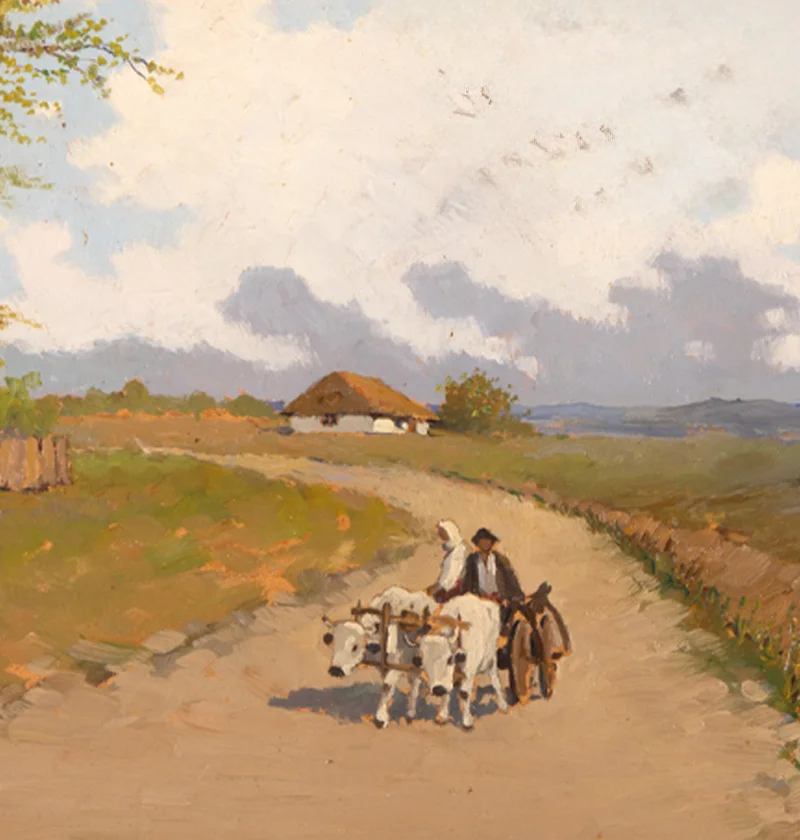
The painting “Hills in Balchik” is subsumed to the pictorial particularities of this period of creation, impressing with the aspect of the Dobrogea space like a vast expanse, covering several consecutive planes, to the most distant ones of the horizon.
Dimenzije
width 65.5 cm, height 53 cm
Opis
oil on canvas, signed lower right, in black, "Dărăscu"
Informacije o istraživanju
Opera a participat la expoziția retrospectivă Nicolae Dărăscu, Muzeul de Artă al R.S.R., 1966 și este menționată și reprodusă în catalogul expoziției, la cat. 103.
PODRIJETLO
collection of Acad. Victor Eftimiu, poet, playwright and art collector.
DODATNE INFORMACIJE
Za pojašnjenja u vezi s postupkom licitiranja, troškovima kupnje, uvjetima jamstva, plaćanja i preuzimanja osvojenog lota preporučujemo da pažljivo pročitate/ponovno pročitate Pravilnik o licitiranju.
“…Nicolae Dărăscu reflects in his canvases the vigour of a positive, manly character. His paintings are organised in a logical, daring manner, with no exception – with an energy harnessed by tight discipline, which allows no mistake in the realm of fantasy and does not accept concessions to sensitivity. Partially faithful to Impressionism, in Dărăscu’s art we can feel his exclusive concern for colour and light.” (N.N. Tonitza, “Two great landscape painters…”, Universul Literar, 10 April 1927, apud Catalogue of the "Nicolae Dărăscu" Retrospective Exhibition, Art Museum of the Socialist Republic of Romania, Bucharest, 1966)
A representative artist of the interwar period, Nicolae Dărăscu felt attracted by two great art movements: Impressionism and Neo-Impressionism. The former offered him the chance to express himself through colour, a need that existed in a certain side of Dărăscu’s personality, while the principles of the latter corresponded to his tendency to subordinate the impressions of a precise rule. From the very beginning, Dărăscu’s works place the painter in the realm of landscape themes, a genre that brought his well-deserved establishment in the history of Romanian art. Focusing on a few composition schemes, Dărăscu remained faithful to nature as a subject throughout his fifty years of artistic activity, the variety of his landscapes being closely linked to the chromatic palette and the atmosphere he creates in each of them. Songs of the Romanian space, Dărăscu’s landscapes are built with wide touches, with slight chromatic passages, focusing light in a few centres of colour, by way of vivid harmonies. Paris and Provence, later inspirations, come to life in works where chromatic harmonies are replaced by vigorous coordinations of bright colours.
The years 1920-1944 identify with the second period of creation – out of the three – when Dărăscu reached his artistic maturity, asserting himself in the landscape of Romanian art. The chromatic of these years leaves behind the harmonies of bright colours, typical of the previous years, while preserving the joy of light. Along with the red and blue tones of the Italian places, the clear, transparent blue of the seascapes in the Delta and the warm ochre accords of Dobrogea landscapes, although vivid, no longer have the same strength as those in the previous period. Now the artist aims to express his refinement by way of delicate colours. The period between the two World Wars finds an extraordinary interpreter of the picturesque and of the splendours typical of Dobrogea in Dărăscu’s landscapes. Turkish cafés, Tatar neighbourhoods, the mosques, the Oriental cemeteries are watched at various times of the year and the day, every time under the effects of a different light. The nature now seems quiet, bright, conveying a sense of resignation and meditative peace that spreads to the artist’s entire body of work.
The painting “Hills in Balchik” is subsumed to the pictorial particularities of this period of creation, impressing with the aspect of the Dobrogea space like a vast expanse, covering several consecutive planes, to the most distant ones of the horizon.
DODATNE INFORMACIJE
Za pojašnjenja u vezi s postupkom licitiranja, troškovima kupnje, uvjetima jamstva, plaćanja i preuzimanja osvojenog lota preporučujemo da pažljivo pročitate/ponovno pročitate Pravilnik o licitiranju.
oil on canvas, signed lower right, in black, "Dărăscu"
Informacije o istraživanju
Opera a participat la expoziția retrospectivă Nicolae Dărăscu, Muzeul de Artă al R.S.R., 1966 și este menționată și reprodusă în catalogul expoziției, la cat. 103.
PODRIJETLO
collection of Acad. Victor Eftimiu, poet, playwright and art collector.