Fotografije parcele su informativne i indikativne te ne mogu pružiti vrlo detaljan prikaz objekta iz svih kutova. Preporučujemo pažljiv fizički pregled parcele prije licitiranja.
Fotografije parcele su informativne i indikativne te ne mogu pružiti vrlo detaljan prikaz objekta iz svih kutova. Preporučujemo pažljiv fizički pregled parcele prije licitiranja.
Bălașa's art is suffused with myths in which man and the Universe have a strong connection. Therefore, the themes of his creations draw on Romanian legends, history, and contemporary life, as well as in myths and symbols. Examples of this are: "Fairy of the Dawn (1973)", "Flight (1981)", "Journey (1985)", "Moon's Daughter (1988)", or "The New World (1995)".
He builds his own magical and transcendental universe, with deeply rooted spiritual elements, developing a style with metaphysical chords, populated by archetypal figures, mythological beings, and a cosmic world.
Bălașa addresses themes from universal legends and mythology and often sketches subjects such as life and death, childhood and youth or the hope of rebirth, where his art appears understood as an eternal dream, but also as a relationship between human consciousness and the cosmos, emphasized by a poetically-philosophical atmosphere and a mystical-romantic aesthetic.
The major themes of his paintings are represented by female characters with a mythical air, male characters depicted in acts of meditation, physical labor or animals reminding of a hybrid between hornless unicorns and centaurs. Besides these, the environment and background of his paintings resemble the depths of an ocean or images that describe existence and survival on other planets.
For him, the human figure is essential in his creation. Among human figures, he preferred youth. Most of his characters are female characters rendered nude, enjoying what nature has offered most attractive and perfect.
In addition to the classic beauty he addresses, another element he takes into account in his works is the purity of gesture, the rigorous line of the body, the mysterious and enigmatic figure of young women such as: “Water Dream” (1976), “Amazons” (1976), “Wild Flower” (1977), “Celestial Journey” (1980), “Marine Universe” (1980), “Fantastic World” (1982) or “At Dusk” (1987).
The dominant color in Bălașa's works is blue, with an ultramarine shade, uniform, laid homogeneous and clear. Blue is not just any color for him, it has profound connotations related to the Romanian space, being the distant celestial light.
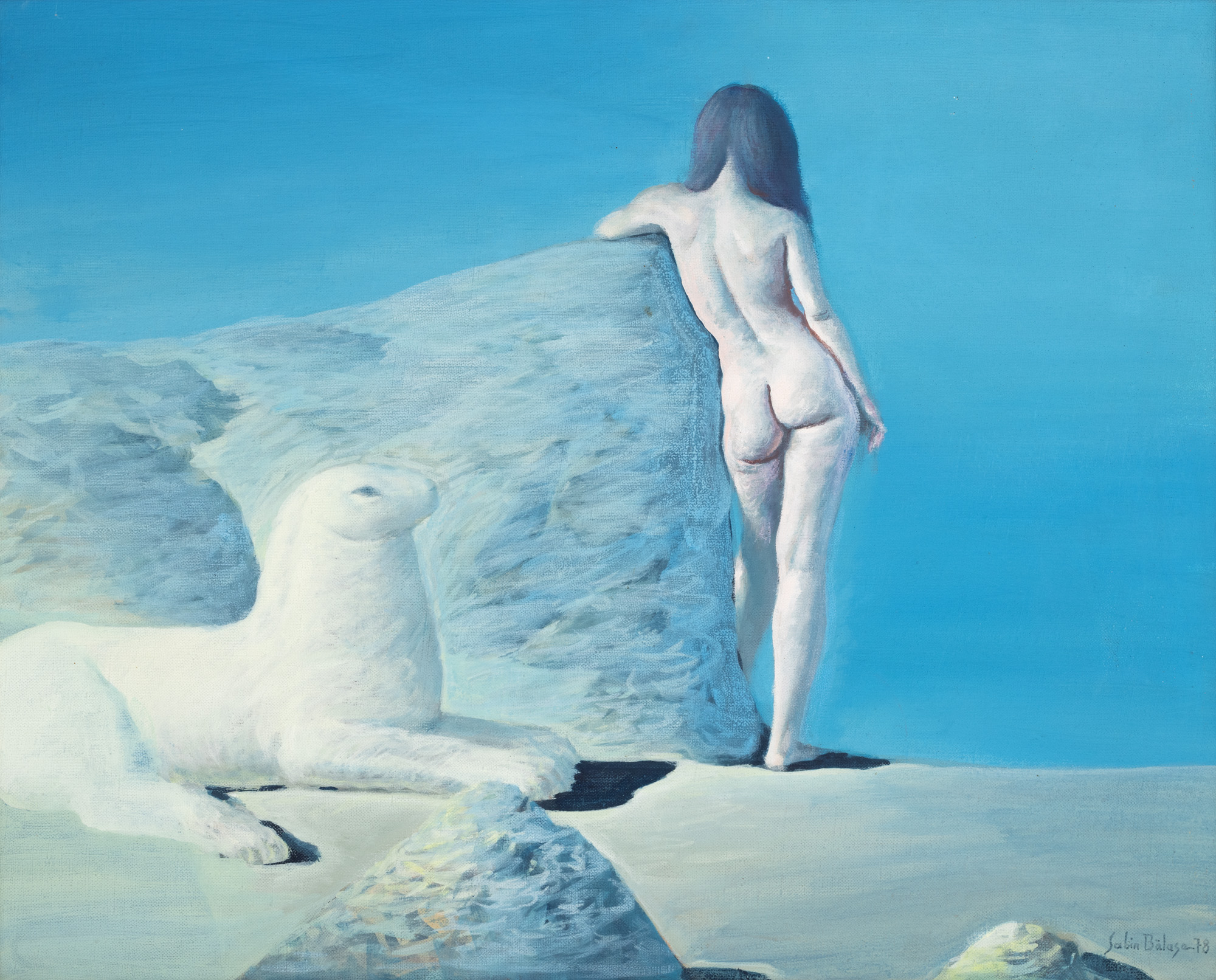
As for the present work, the center of interest focuses on the representation of a female nude and a mythological animal that is positioned further away from the character.
The young woman has black hair and is completely turned with her back to the viewer, leaning on the background rocks admiring the vast blue landscape. The mythical animal, similar to a unicorn, is white, is seated by the rocks, with its gaze directed forward, also gazing into the distance at this landscape, together with the girl.
The most predominant colors in the composition are blue, white and black, where an apparent balance in the arrangement of shapes and colors can be observed. Bălașa harmoniously combines these to create distinctive compositional relationships and shades in his work.
ulei pe pânză, signed and dated lower right, in black, "Sabin Bălașa, (19)78"
Izlasci
1978
DODATNE INFORMACIJE
Za pojašnjenja u vezi s postupkom licitiranja, troškovima kupnje, uvjetima jamstva, plaćanja i preuzimanja osvojenog lota preporučujemo da pažljivo pročitate/ponovno pročitate Pravilnik o licitiranju.
Bălașa's art is suffused with myths in which man and the Universe have a strong connection. Therefore, the themes of his creations draw on Romanian legends, history, and contemporary life, as well as in myths and symbols. Examples of this are: "Fairy of the Dawn (1973)", "Flight (1981)", "Journey (1985)", "Moon's Daughter (1988)", or "The New World (1995)".
He builds his own magical and transcendental universe, with deeply rooted spiritual elements, developing a style with metaphysical chords, populated by archetypal figures, mythological beings, and a cosmic world.
Bălașa addresses themes from universal legends and mythology and often sketches subjects such as life and death, childhood and youth or the hope of rebirth, where his art appears understood as an eternal dream, but also as a relationship between human consciousness and the cosmos, emphasized by a poetically-philosophical atmosphere and a mystical-romantic aesthetic.
The major themes of his paintings are represented by female characters with a mythical air, male characters depicted in acts of meditation, physical labor or animals reminding of a hybrid between hornless unicorns and centaurs. Besides these, the environment and background of his paintings resemble the depths of an ocean or images that describe existence and survival on other planets.
For him, the human figure is essential in his creation. Among human figures, he preferred youth. Most of his characters are female characters rendered nude, enjoying what nature has offered most attractive and perfect.
In addition to the classic beauty he addresses, another element he takes into account in his works is the purity of gesture, the rigorous line of the body, the mysterious and enigmatic figure of young women such as: “Water Dream” (1976), “Amazons” (1976), “Wild Flower” (1977), “Celestial Journey” (1980), “Marine Universe” (1980), “Fantastic World” (1982) or “At Dusk” (1987).
The dominant color in Bălașa's works is blue, with an ultramarine shade, uniform, laid homogeneous and clear. Blue is not just any color for him, it has profound connotations related to the Romanian space, being the distant celestial light.
As for the present work, the center of interest focuses on the representation of a female nude and a mythological animal that is positioned further away from the character.
The young woman has black hair and is completely turned with her back to the viewer, leaning on the background rocks admiring the vast blue landscape. The mythical animal, similar to a unicorn, is white, is seated by the rocks, with its gaze directed forward, also gazing into the distance at this landscape, together with the girl.
The most predominant colors in the composition are blue, white and black, where an apparent balance in the arrangement of shapes and colors can be observed. Bălașa harmoniously combines these to create distinctive compositional relationships and shades in his work.
DODATNE INFORMACIJE
Za pojašnjenja u vezi s postupkom licitiranja, troškovima kupnje, uvjetima jamstva, plaćanja i preuzimanja osvojenog lota preporučujemo da pažljivo pročitate/ponovno pročitate Pravilnik o licitiranju.