


Meniu

Hrvatski

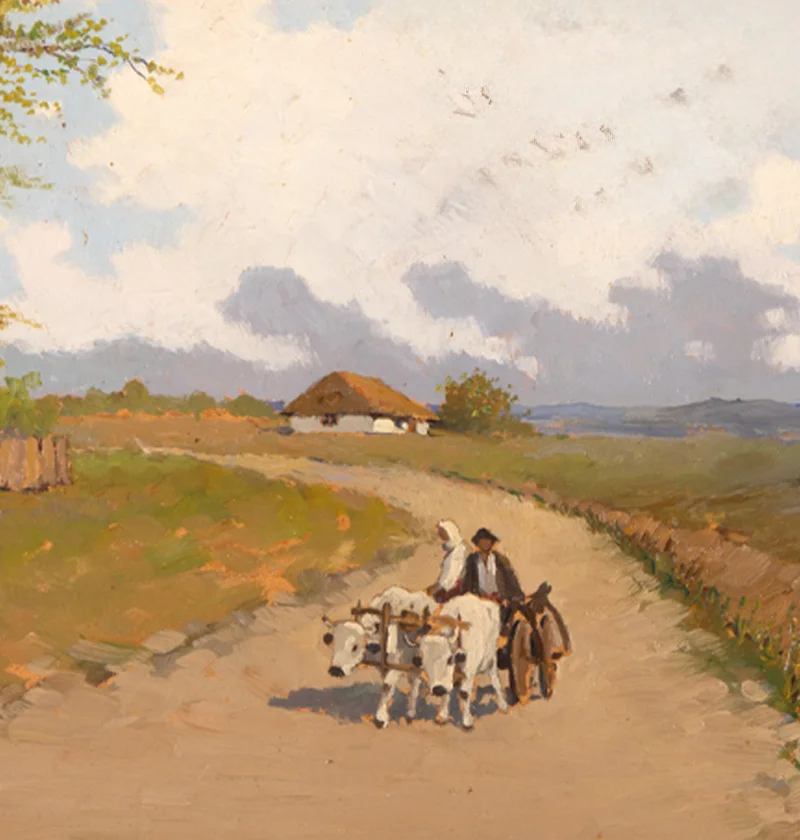
160. Haymaking [cca. 1901]

1838, Pitaru, Dâmboviţa - 1907, Câmpina

Procjena

EUR 40.000 - 60.000

Prodano

EUR 50.000

Sesija

Čet., 12 prosinca 2024 17:00

The year 1891 marked the definitive settling of the painter in Câmpina. The settlement in Prahova county was a point of interest at that time for many significant personalities of the time: Ion Heliade Rădulescu, George Barițiu, Dimitrie Bolintineanu, Alexandru Vlahuță, Bogdan Petriceicu Hașdeu or George Coșbuc; personalities who probably stayed here driven by the climate and pictorial location. However, the artist's journey was deeply tied to rural life since his studies abroad. During his stay in Paris, Nicolae Grigorescu aprender from his schoolmates about the existence of the group of artists in Barbizon. He joined the movement towards a much more realistic painting and worked alongside some of the French art leaders: Rousseau, Courbet, Millet, Monet or Renoir. At Barbizon, he was inspired by the life of the French peasants and transposed onto the canvas landscapes and human figures specific to the geographical space in which he worked. Grigorescu mainly acquired an attitude towards life and the purpose of art here, leaving the painterly manner to converge to a secondary plane. During his studies in France, his predilection for landscape is deeply accentuated. Therefore, his subsequent predilections for the landscapes that faithfully mirror nature are not surprising. From Barbizon to Câmpina, the Romanian painter developed a palpable interest and a immeasurable love for rural subjects. His landscapes describe fields, hills, haystacks, small huts hidden as if in nature, houses or herds of oxen. His skies are often clear, a sign that he painted landscapes in a perfect atmosphere. His final years of creation coincide with opening of his entire chromatic palette, so that nuances of white will prevail, or the faintest variations of once stronger colors. True panoramas of the Romanian village will be transposed into works such as "Cheile Dâmbovicioarei", "House in Valea Moșneagului", "Vatra de la Rucăr", "On the banks of the Siret", "Landscape at Sinaia", "Schitul Peștera", "Landscape at Posada". Among his favorite places to penetrate the secrets of rural life are Câmpulung, Rucăr, Dâmbovicioara or Câmpina. His observations of nature will be transcribed through sincere emotion and a special sensitivity to the surrounding world. "He was never and didn't feel anything else but a humble confidant of nature", observed Alexandru Vlahuță. The house from Câmpina - the old inn of the wagoners - therefore became the perfect opportunity to enjoy life in full communion with nature. Nicolae Grigorescu will actively seek captivating panoramas and frescoes throughout his artistic career and will immortalize the beauty of his native lands with an unequalled virtuosity.

Literatura

VLAHUȚĂ, Alexandru, "Painter Grigorescu - His life and work", Alexandru Vlahuță, Bucharest, 1910. Petrașcu, Nicolae, "N. Grigorescu", "Bucovina" Typography, I.E. Toroutiu, Bucharest, 1930. Brezianu, Barbu, "Nicolae Grigorescu", Youth Publishing House, Bucharest, 1959. Jianu, I .; Vasiliu, G., "Dr. C.I. Istrati", Scientific Publishing House, Bucharest, 1964. OPRESCU, George, "Nicolae Grigorescu", Meridiane Publishing House, Bucharest, 1963. CEBUC, Alexandru, "Grigorescu", Official Monitor, 2017.

Dimenzije

width 41 cm, height 27.5 cm

Opis

oil on canvas, signed bottom right, in red, "Grigorescu"

Izlasci

cca. 1901

DODATNE INFORMACIJE

Za pojašnjenja u vezi s postupkom licitiranja, troškovima kupnje, uvjetima jamstva, plaćanja i preuzimanja osvojenog lota preporučujemo da pažljivo pročitate/ponovno pročitate Pravilnik o licitiranju.

Za dodatne informacije o lotu i aukciji kontaktirajte Odjel umjetničkih savjetnika.

Alternativni lotovi